
In this guide
THE SHORT ANSWER
The essentials.
Pure-water window cleaning uses treated water through a hose, pole and brush to loosen and rinse away dirt. Removing dissolved minerals reduces spotting from the water itself, but a good finish also requires effective agitation, rinsing and equipment care.
KEEP THESE IN MIND
01
Check water quality rather than judging it by appearance.
02
Choose filtration using your incoming water and daily consumption.
03
Maintain the brush, hose and system as well as the filters.
GUIDE / 01
What “pure water” means in window cleaning
In this context, pure water means water treated to reduce dissolved mineral content before cleaning and rinsing. It is commonly produced using deionisation (DI), reverse osmosis followed by DI, or obtained from a suitable supplier.
The purpose is to reduce the residue left by the rinse water as it dries. It does not mean that the water is sterile, drinking water, or able to remove every type of contamination. A TDS meter helps monitor dissolved solids; it is not a complete test of water safety or cleanliness.
GUIDE / 02
How the cleaning process works
- The delivery system supplies treated water through the hose and pole.
- The brush agitates dirt on the suitable glass and frame surfaces.
- A thorough rinse carries loosened dirt away.
- The cleaned surface is left to dry, then checked for remaining marks.
There is no need to describe the water as “magnetic” or “hungry”. Brush work and rinsing do the practical cleaning. Frames, seals, a contaminated brush or persistent deposits can still affect the result.
GUIDE / 03
Choose how to obtain your water
Approach | What it does | What to consider |
|---|---|---|
DI only | Uses ion-exchange resin to remove dissolved ions | Incoming water quality, resin use and daily volume |
RO followed by DI | Reduces dissolved solids with a membrane, then polishes with resin | Feed conditions, production rate, reject water and maintenance |
Bought-in purified water | Supplies water for a delivery-only setup | Availability, transport, quality checks and storage |
Production capacity and carrying capacity are separate decisions. Compare the RO and DI options before choosing a tank size.
GUIDE / 04
Where the method helps—and where it does not
A suitable water-fed pole can let you clean some exterior windows from ground level. It can also allow frames and glass to be washed in one routine. Assess each site and use the pole within its instructions; ground-level work still involves hazards.
Traditional cleaning remains useful, particularly indoors and where water runoff is unsuitable. A correctly used squeegee removes the cleaning solution rather than leaving tap water to dry. Neither method is automatically best for every job.
Specialist stains, damaged surfaces and coated glass may need different treatment. Follow the surface manufacturer’s instructions before changing brushes or adding chemicals.
GUIDE / 05
Keep the water clean through the whole system
- Monitor the final output and record changes in TDS.
- Keep the tank, hose and brush protected from contamination.
- Maintain pre-filters, membranes and resin as instructed.
- Inspect the dried result instead of relying on a meter alone.
- Include water use, consumables and maintenance when comparing running costs.
For a practical cleaning routine, read how to clean windows with a water-fed pole.
YOUR QUESTIONS, ANSWERED
Questions and answers
Does pure water guarantee spot-free glass?
No. It reduces mineral residue from the water, but technique, rinsing and contamination also affect the finish.
Does every professional use pure water?
No. Professional cleaners choose methods to suit the site and surface. Many use both water-fed poles and traditional tools.
Is pure-water cleaning detergent-free?
Routine pure-water cleaning can use agitation and rinsing without detergent. Specialist contamination may require a separate approved treatment; follow the equipment and surface instructions.
TWO WAYS TO TREAT YOUR WATER
Different filtration. Same goal.
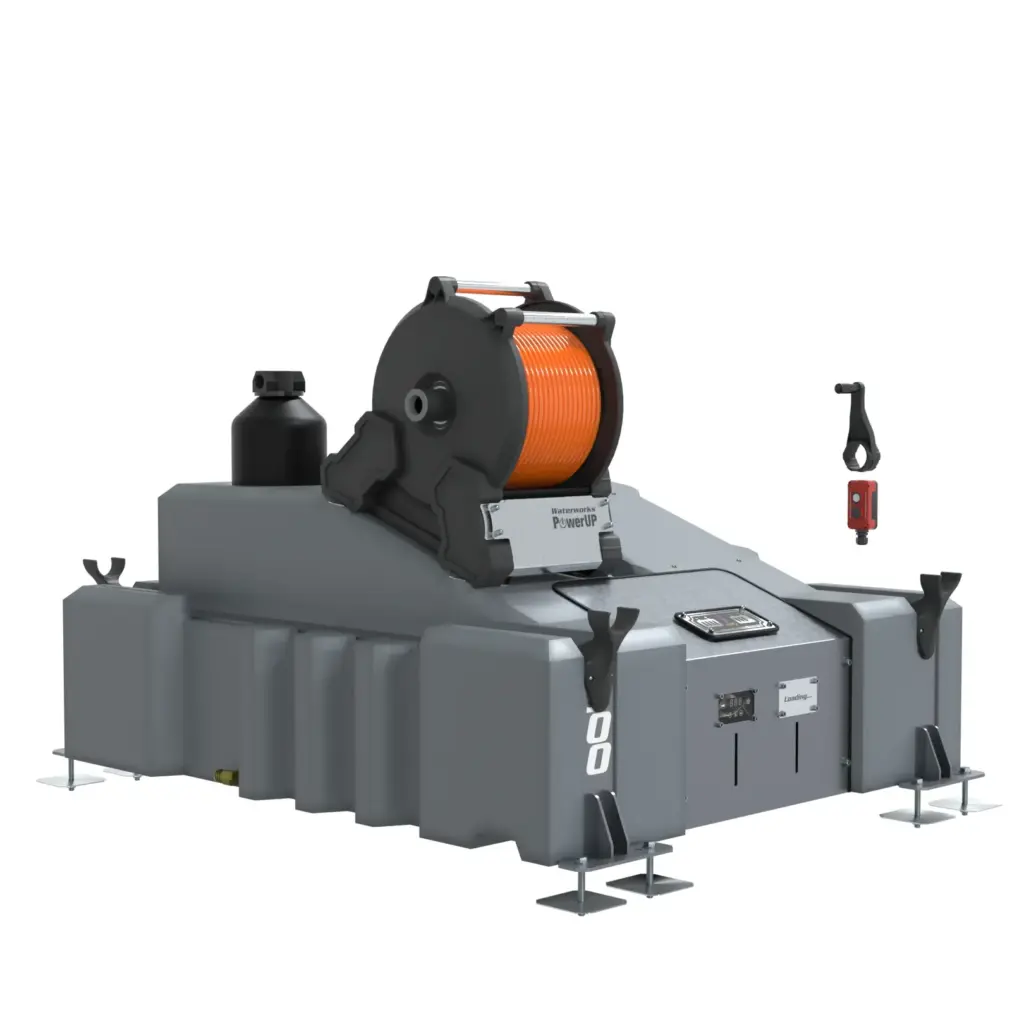
DI systems
Keep filtration simple.
Ion-exchange resin removes dissolved ions. Running costs depend on incoming water quality and how much you use.
Explore DI systems →
RO systems
Build in purification.
A membrane reduces dissolved solids before resin polishing. Check production needs, pressure and maintenance.
Explore RO systems →FROM THE WATERWORKS TEAM
Practical equipment guides from Waterworks in Corby. For advice about your own configuration, contact the team.
YOUR NEXT READ
Keep building your knowledge.
KEEP READING
RO vs DI: choosing a window cleaning system
Read the guide →
KEEP READING
How to clean windows with a water-fed pole
Read the guide →
KEEP READING