

Window cleaning prices typically range from £10–£20 for small homes, £20–£40 for standard properties and £40–£70+ for larger houses. Professionals also charge £1–£8 per window, with first cleans costing 30–60% more. This guide explains pricing formulas, cost factors and real examples to help cleaners set profitable 2025 rates.
Key Facts
- Typical residential prices: £10–£20 for small homes, £20–£40 for 2–3 bed homes, £40–£70+ for larger properties.
- Per-window pricing: Usually £1–£8 depending on size, height, and access difficulty.
- Hourly earning potential: Traditional cleaners average £20–£30/hr; WFP cleaners often achieve £30–£50+/hr due to faster workflow.
- First cleans: Typically 30–60% higher because they require deeper frame and sill work.
- Commercial pricing: Shopfronts often £10–£25 per clean; office buildings £40–£80+ per visit; contracts provide higher long-term value.
In This Article
Understanding How Window Cleaning Prices Are Set (Pro-Level Overview)
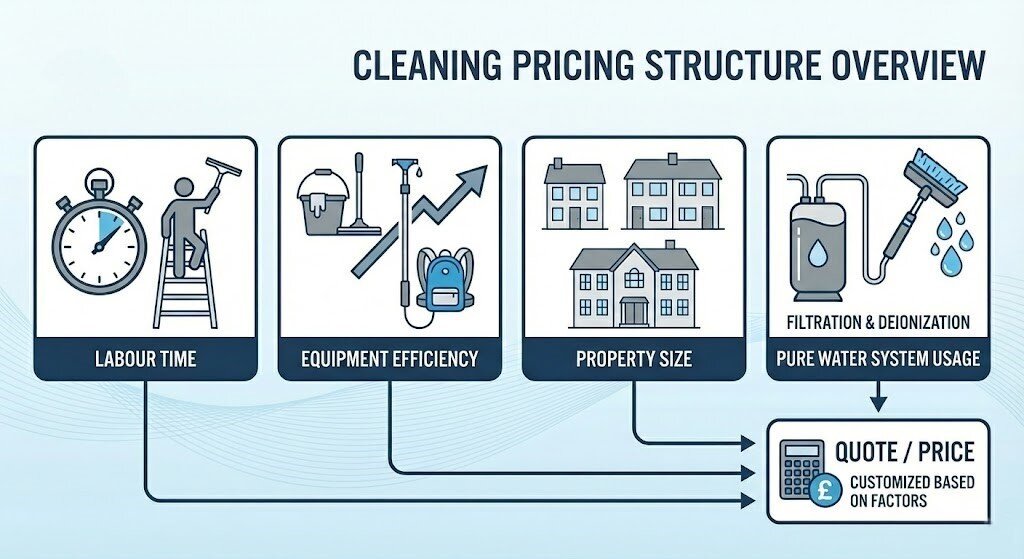
Window cleaning prices vary because no two jobs, routes, or equipment setups are the same. Some professionals charge per property, some prefer a per-window rate, and others use hourly or contract-based pricing. Behind all of these models, the real goal is simple:
Your prices must cover your operating costs and still generate a healthy profit.
To charge confidently, you need to understand how job time, equipment efficiency, property type, consumables, and customer expectations influence what professionals can realistically charge. This section lays the foundation for building a pricing structure that is competitive, sustainable, and profitable.
Why Pricing Matters More in 2026
In 2026, window cleaners must be more strategic with pricing than ever before. Several factors have made correct pricing a core part of running a successful cleaning business:
- Higher operating costs: Fuel, filters, resin, and maintenance costs have increased.
- Greater competition: More cleaners now use modern equipment and offer similar services.
- Customer expectations: Clients want fast, consistent, streak-free results.
- Efficiency gaps: Cleaners using outdated methods earn less per hour.
- Inflation impact: Undercharging is one of the biggest reasons new cleaners struggle financially.
Setting strong, fair prices helps you:
- Protect your profit margins
- Build reliable income
- Justify better equipment investment
- Serve fewer customers while earning more
- Grow your business sustainably
Pricing isn’t guesswork — it’s a business decision.
Why Water-Fed Pole (WFP) Cleaners Charge Differently Than Traditional Cleaners
Traditional window cleaning relies on ladders, manual scrubbing, and time-consuming repositioning. Because it takes longer, pricing often reflects labour intensity rather than efficiency.
Water-fed pole systems (WFP), on the other hand, use purified water delivered through a telescopic pole. This dramatically changes how professionals approach pricing:
Traditional Cleaning
- Slower overall job time
- Limited reach
- Requires ladder work
- Complex or multi-storey properties take longer
- More physical strain
- Repeat cleans still require full manual effort
WFP Cleaning
- Faster cleaning process
- Safe, ground-based reach (no ladders)
- High and awkward windows cleaned easily
- Repeat cleans become significantly quicker
- Consistent spot-free finish
- Higher daily route capacity
Result:
A WFP cleaner completes more jobs in less time, increasing real hourly earnings.
This efficiency allows WFP professionals to set prices based on value and results, not just time spent on the job.
Common Pricing Mistakes New Cleaners Make
Many new cleaners undercharge in the beginning, but this quickly leads to burnout, poor profitability, and unnecessary workload. These are the most common mistakes:
1. Copying local competitors
Competitors may be undercharging themselves — copying them ties your income to their mistakes.
2. Not charging extra for the first clean
First cleans take significantly longer because frames and glass often need deep cleaning.
3. Ignoring travel time and fuel
These hidden costs can turn a profitable job into a loss.
4. Forgetting consumable costs
Filters, resin, brush wear, and pump usage all reduce profit if not priced correctly.
5. Pricing traditional and WFP jobs the same
WFP offers better reach, safer work, and faster turnaround — your pricing should reflect the added value.
6. No profit margin calculation
If you don’t calculate your base cost per job, you can’t set sustainable rates.
Professional pricing isn’t about being the cheapest — it’s about being profitable, efficient, and consistent.
Average Window Cleaning Prices (2026 Benchmarks)
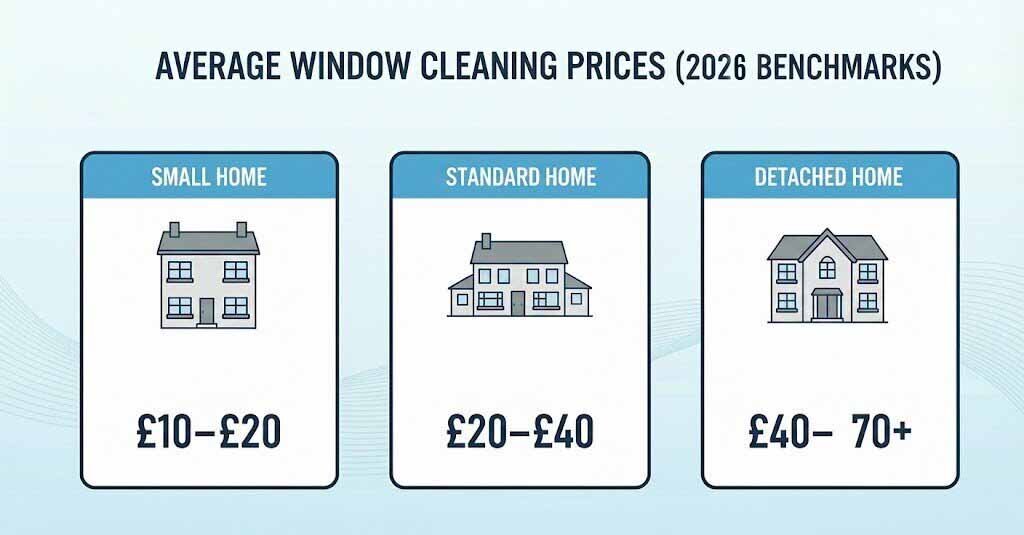
Window cleaning prices vary based on property size, access difficulty, location, frequency, and whether the clean is a first-time or maintenance visit. Although there’s no universal industry tariff, most professionals worldwide follow predictable pricing ranges. Your goal is not to copy these numbers exactly, but to understand where the market typically sits so you can position your own pricing confidently.
Below are industry-standard price ranges based on real professional averages (not tied to any single location or service provider).
Average Price Per Standard Home
Most window cleaners charge per property when handling residential routes. Prices are influenced by:
- Amount of glass
- Number of floors
- Window accessibility
- Method used (traditional vs WFP)
- Frequency of cleaning
Typical Residential Pricing Ranges (2026):
| Property Type | First Clean (Average Range) | Maintenance Clean (Average Range) |
| Small flat / small home | £10–£20 | £8–£15 |
| Standard 2–3 bed home | £20–£40 | £15–£30 |
| Large home / detached | £40–£70+ | £30–£55 |
Why first cleans cost more:
- Deep cleaning required
- Dirt buildup on frames and sills
- High-reach or awkward panes
- Takes 2× longer than repeat visits
Once a house is on a regular schedule, cleaning becomes faster and more efficient — especially with a WFP system — allowing cleaners to maintain competitive prices while improving hourly earnings.
Average Price Per Window
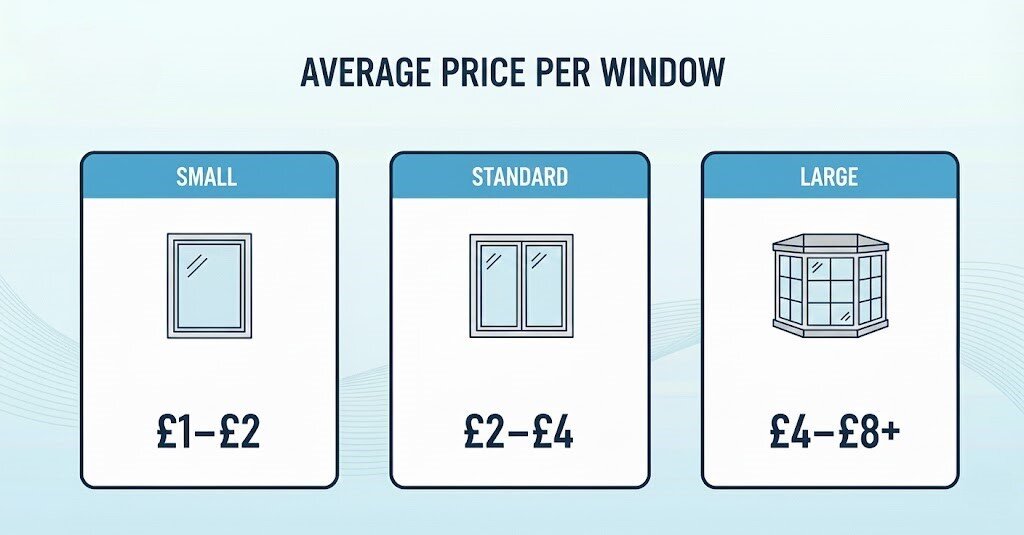
Some professionals, especially those cleaning commercial interiors, apartment blocks, or buildings with uniform panes, prefer per-window pricing.
Typical Per-Window Pricing Ranges:
- Small windows: £1–£2 each
- Standard residential panes: £2–£4 each
- Large panes / shopfront glass: £4–£8+ each
- High-reach windows: Add 20–40% depending on access difficulty
Per-window pricing works well when:
- The building has many identical panes
- You clean interior glass
- You want predictable pricing
- The client prefers a clear breakdown
Average Hourly Rate for Professional Window Cleaners
Professional cleaners rarely advertise hourly rates, but internally they track earnings per hour to measure profitability.
Typical Earning Potential Per Hour:
- Traditional cleaning: £20–£30 per hour
- WFP cleaning: £30–£50+ per hour
Why the difference?
- WFP systems reduce physical effort
- Fewer ladder moves
- Faster cleaning cycles
- Higher route density
- Faster repeat visits
- More commercial opportunities
A well-set-up WFP cleaner with an efficient van-mounted system can easily complete 10–20% more jobs per day, raising real hourly earnings substantially.
Typical Commercial Cleaning Rates (Shops, Offices, Retail Units)
Commercial pricing is usually higher and more complex because these jobs involve:
- Larger panes
- Greater frontage
- Regular cleaning schedules
- Out-of-hours work
- Higher reach requirements
- Safety considerations
Typical Commercial Pricing Ranges:
- Small shopfront (weekly/fortnightly): £10–£25 per clean
- Large retail frontage: £25–£60+ per clean
- Small office buildings: £40–£80+ per visit
- Multi-floor office blocks: Contract-based pricing (monthly/quarterly)
Most commercial clients prefer contracts rather than one-off pricing.
This gives cleaners predictable income and route stability — making commercial work one of the most profitable opportunities for WFP professionals.
Pricing Note
All pricing ranges in this guide are based on common industry averages used by professional window cleaners. Actual rates vary depending on your country, local market, equipment setup, property type, and service frequency. Waterworks does not provide window cleaning services — this guide is designed to help professionals set fair, profitable prices using modern pure-water systems.
Pricing Based on Cleaning Method (Traditional vs Water-Fed Pole)
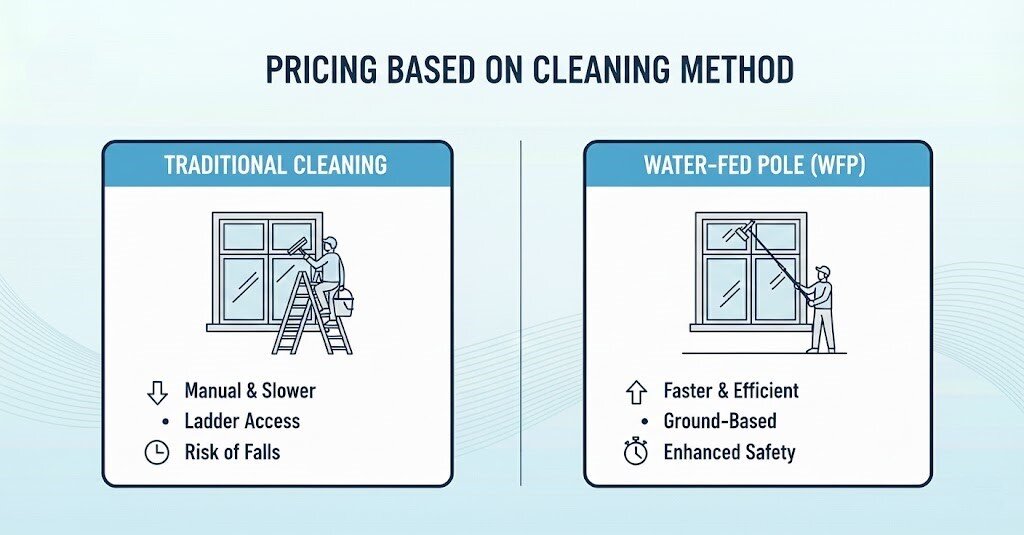
Your cleaning method has a direct impact on how much you should charge. Traditional window cleaning and water-fed pole (WFP) systems deliver different speeds, levels of safety, reach, and overall efficiency. Because of this, the pricing logic is not the same for both methods — and understanding the difference helps you set rates that reflect the true value of your service.
Traditional Window Cleaning — Pricing Logic
Traditional window cleaning relies on ladders, squeegees, applicators, and manual scrubbing. While this method still works effectively for some jobs, it comes with built-in limitations that influence your pricing:
Why Traditional Pricing Is Often Higher per Job but Lower per Hour
- More time per window due to ladder repositioning
- Limited reach, especially above first floor
- Greater physical effort, making repeated routes slower
- Safety considerations when working at height
- More labour required on larger or complex properties
Traditional cleaners often price jobs based on the time and effort required, not volume.
This means:
- Large homes cost more
- Upper floors add extra charges
- Frames and sills take significantly longer
- Maintenance cleans still require full manual work
Although traditional pricing per job can be high, the slower workflow reduces hourly earning potential.
Water-Fed Pole (WFP) Cleaning — Pricing Logic
WFP cleaning uses purified water pumped through a telescopic pole, allowing you to clean safely from the ground and reach windows that would normally require ladders or multiple staff members. This dramatically changes how professionals approach pricing.
Why WFP Pricing Justifies Higher Rates and Higher Earnings
- Faster cleaning cycles → more jobs per hour
- Higher reach without extra equipment
- Consistent, streak-free finish thanks to pure water
- Safer workflow → less downtime & fewer risks
- Repeat cleans are significantly quicker
- No ladders needed, reducing job complexity
- Higher-capacity jobs (schools, offices, flats) become realistic
Because WFP cleaning offers superior speed, quality, and safety, professionals can confidently charge:
- Similar or higher prices per clean
- While completing work in less time
- Resulting in significantly higher hourly earnings
This is why WFP cleaners dominate commercial and high-volume residential routes.
How a WFP System Increases Your Earning Potential
A well-designed pure-water system directly increases your real hourly rate — not by charging more, but by allowing you to complete more work in less time.
Below are the core efficiency factors that impact profitability:
1. Tank Capacity (500L / 750L / 1000L)
Your tank capacity determines how long you can work without refilling:
- 500L → Ideal for solo operators
- 750L → Balanced domestic + commercial routes
- 1000L → High-volume commercial work or multi-operator setups
More water = fewer breaks = more daily jobs = higher total earnings.
2. Hose Reel Type (Manual vs Electric)
Reels significantly affect job time.
- Manual reels are effective but slow for high-volume routes
- Electric reels (like PowerUP XL–style systems) reduce setup and pack-down time dramatically
- Over a full day, this saves 30–60 minutes, often enough to add an extra job
Faster setup → more jobs → higher revenue.
3. Pump & Flow Controller Efficiency
Stable flow and controlled pressure allow for:
- Faster rinsing
- Consistent cleaning results
- Reduced rework
- Improved water use efficiency
A well-tuned system increases job speed without reducing quality.
4. Pure Water Quality (RO/DI or DI-Only)
Purified water leaves glass spotless without chemicals.
Better water purity means:
- No streaks
- No residue
- No need for repeat passes
- Faster job completion
- Fewer complaints → stronger customer retention
5. Reach & Safety Advantage
WFP enables cleaners to work entirely from the ground:
- No ladder repositioning
- No scaffolding
- No harnesses for standard routes
- No two-person teams for high windows
This makes high-reach and awkward windows profitable rather than time-consuming.
Factors That Influence How Much You Should Charge
Every window cleaning job is different, which means your pricing must remain flexible. Professionals don’t rely on a fixed chart — instead, they evaluate key factors that determine how long a job will take, how difficult it is, and what resources it will consume.
Understanding these variables helps you set prices that are fair, profitable, and aligned with industry expectations.
Property Type (Domestic, Commercial, Multi-Storey)
The type of building heavily influences your pricing:
Domestic Properties
- Faster to clean
- Lower access issues
- Predictable layouts
- Best suited for route-based pricing
Most cleaners price by property size, such as small flats, 2–3 bed homes, or large detached houses.
Commercial Properties
- More glass surface area
- Larger frontage
- Frequent cleaning schedules
- Often require early/late access
- Higher reach needs (above first or second floor)
These factors justify higher pricing or contract-based rates.
Multi-Storey Buildings
- Rope access or high-reach poles
- Safety considerations
- Additional time for rinse cycles
- Potential multi-operator work
These jobs require specialist equipment and therefore command premium pricing.
Access Difficulty & Height
Even standard homes have access challenges:
- Narrow pathways
- Obstructed windows
- Conservatory roofs
- Limited ladder-safe areas (for traditional cleaners)
- High or awkward panes requiring extended poles
WFP systems reduce most of these difficulties, but if the job requires extra movement, hose routing, or repositioning, you should factor that into your price.
First Clean vs Maintenance Clean
First cleans typically take 2–3× longer because:
- Dirt, dust, and cobweb buildup
- Frames and sills require deep scrubbing
- Residue and spotting take extra rinse time
- Customer hasn’t had a schedule for months or years
This is why professionals always charge:
- Higher for the first clean
- Lower for maintenance cleans
Once on a schedule (monthly or every 4–8 weeks), jobs become faster and more predictable, especially with a WFP setup.
Frequency of Service
Cleaning frequency significantly impacts your pricing model:
- One-off cleans: Highest price
- Monthly: Standard price
- Every 6–8 weeks: Slight surcharge
- Weekly/fortnightly for shops: Lower per-visit price, higher annual value
Professional cleaners often secure route-based routes by offering a small discount for regular repeat work — improving route stability and long-term income.
Level of Dirt & Glass Condition
Heavily soiled windows, builders’ cleans, algae, hard water marks, or long-neglected frames require:
- More scrubbing
- More rinse cycles
- More pure water
- More time on-site
You should always price these jobs higher, especially if:
- Frames have never been cleaned
- Sills require detailing
- Glass shows mineral deposits
- External pollution or traffic film is heavy
This is a major time factor overlooked by beginners.
Travel Time & Fuel Costs
Any route that requires long travel time reduces profitability unless priced correctly.
You should adjust prices if:
- The job is far from your regular route
- Traffic delays are common
- Customer is in a rural or low-density area
- Your area has rising fuel costs
Efficient route planning can double your daily income — especially when using van-mounted WFP systems with large tank capacity.
Consumables (Resin, Filters, Brushes, Equipment Wear)
Pure-water cleaning relies on:
- DI resin
- RO membranes
- Carbon filters
- Brushes
- Hose wear
- Pump usage
- Flow controller run time
Even though each unit cost is small, they add up over hundreds of cleans.
Professionals price to ensure these consumables are covered within their margin.
This is where WFP efficiency shines — despite consumable costs, the speed advantage increases overall profitability.
Weather & Regional Differences
Weather affects pricing because it changes:
- Workability
- Safety
- Job timing
- Equipment strain (pumps/hoses)
- Customer expectations
Regional differences also matter:
Urban areas may accept higher prices; rural areas often require flexible pricing to justify travel.
However, the goal is consistency — not undercutting.
How to Calculate Your Window Cleaning Prices (Professional Formula)
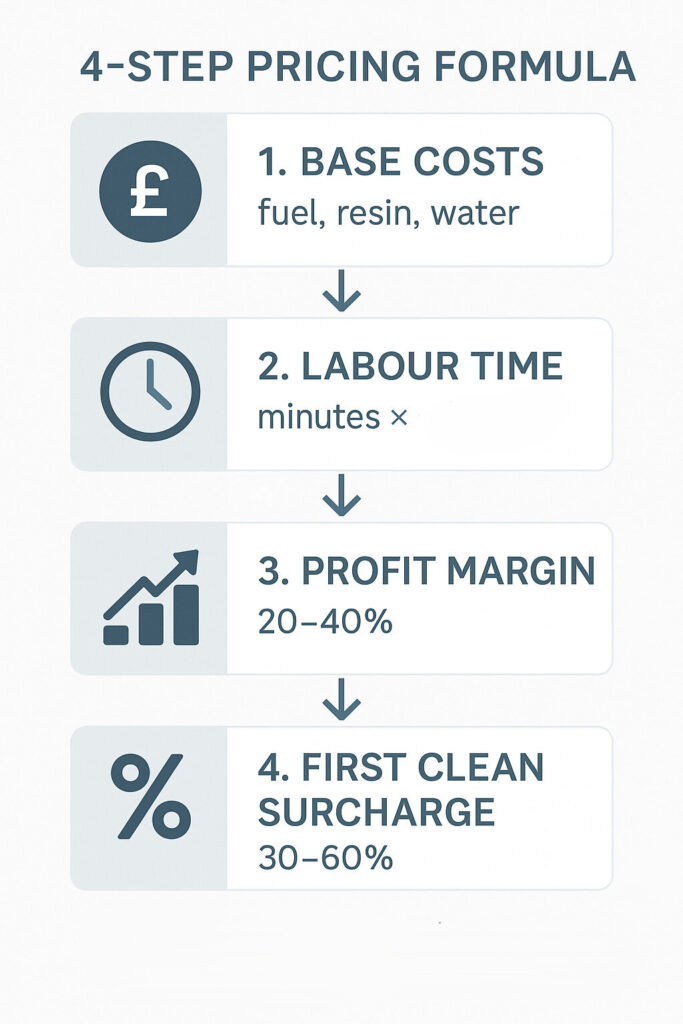
Professionals don’t choose prices randomly — they use a simple but powerful formula that ensures every job is profitable. This framework helps you calculate prices for domestic, commercial, and route-based work in a consistent, repeatable way.
The key is to understand your cost per job, your time investment, and the profit margin you want to maintain.
Below is the industry-standard calculation used by experienced window cleaners.
Step 1 — Calculate Your Base Cost Per Job
Your base cost includes everything required to complete the job — even small expenses.
Base cost components:
- Fuel: Driving to and from the property
- Pure water usage: (Especially relevant for RO/DI and DI-only systems)
- Resin and filter wear: Consumables used during WFP cleaning
- Brush, hose, and reel wear: Minor but cumulative
- Vehicle maintenance: Tyres, oil, pump battery usage, etc.
- Time investment: Travel time + on-site time
Estimate your average base cost per job.
For many professionals, this lands between £3–£10 per domestic job, depending on area and system type.
WFP systems are more efficient but do require consistent resin/filters — still, their overall profitability is higher due to speed.
Step 2 — Add Your Labour Time (Per-Minute Calculation)
Your time is your most valuable resource.
Professionals calculate labour value this way:
- Choose your target hourly earning (e.g., £30–£50 per hour).
- Convert it to a per-minute value (e.g., £0.50–£0.83 per minute).
- Multiply it by the number of minutes a job takes.
Example:
If a clean takes 20 minutes and you aim for £40/hour:
- £40/hour = 66p per minute
- 20 minutes × £0.66 = £13.20 labour value
This keeps your pricing logical and profitable.
Step 3 — Add Your Profit Margin
A strong business includes a profit margin on top of basic labour + cost.
Typical professional margins:
- Residential jobs: 20–40%
- Commercial jobs: 30–50%
- Contract routes: Lower per-clean margin but higher annual income
Profit margin ensures:
- You can reinvest in better equipment
- You don’t undercut your own growth
- You maintain long-term sustainability
Professionals often build margin into their overall price rather than listing it separately.
Step 4 — Include a First Clean Surcharge
First cleans take 2–3× longer because:
- Frames and sills need restoring
- Glass needs full detailing
- Heavy dirt, cobwebs, residue, and spotting require extra time
Typical surcharge ranges:
- +30% to +60% depending on condition
- Heavily neglected properties may require double your maintenance price
This surcharge protects your time and ensures every job is worth doing.
Step 5 — Set Your Maintenance Price
Maintenance cleans (every 4–8 weeks) are much quicker, especially with WFP systems.
Typical maintenance logic:
- 30–50% quicker than first cleans
- Lower pure water usage
- Less frame scrubbing
- Consistent results with less effort
Your maintenance price should reflect:
- Time saved
- Customer loyalty
- Predictable route scheduling
Professionals often charge:
- First clean: Higher rate
- Maintenance: Lower rate
But the hourly earning remains higher due to speed.
Example Table: Traditional vs WFP Pricing Formula (Simplified)
| Factor | Traditional | WFP |
| Time per job | Longer | Faster |
| Consumables | Low | Moderate |
| Access difficulty | Higher | Lower |
| Safety | Lower | Higher |
| Reach | Limited | Extended |
| Effective hourly rate | £20–£30/hr | £30–£50+/hr |
| Best pricing model | Labour-based | Value-based |
WFP systems consistently deliver higher earnings, especially when paired with larger tanks, electric reels, and efficient route planning.
Real-World Pricing Examples (Professional Breakdown)
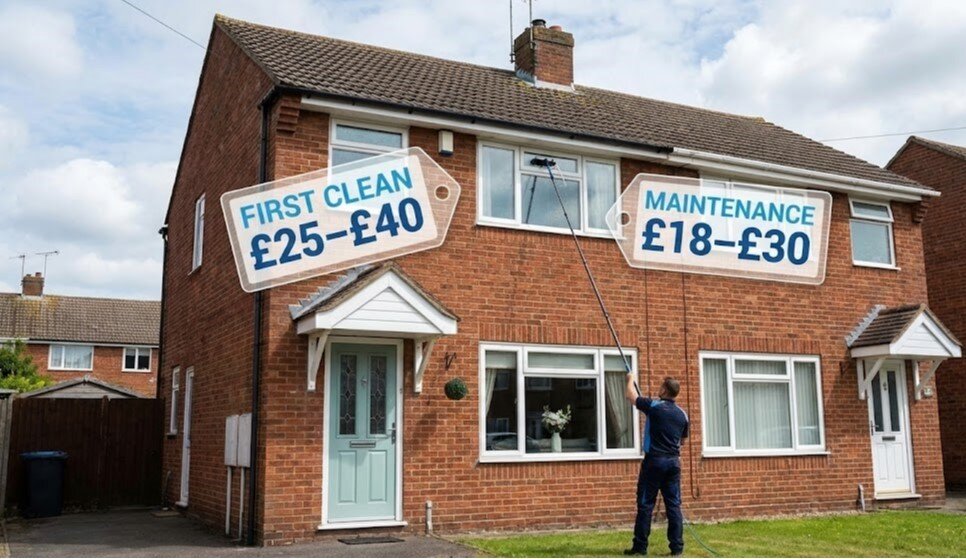
While every job is unique, it helps to see how real cleaners structure their pricing in practical scenarios. These examples are based on common industry averages and show how job type, time, and method (traditional vs WFP) influence what professionals typically charge.
These aren’t fixed prices — they are benchmarks showing how to apply the pricing formula from the previous section.
Use the Waterworks System Builder to create a setup tailored to your vehicle, workload, and budget.
Example 1 — Standard 3-Bed Semi (First Clean + Maintenance)
A very common residential job.
First Clean (Typical Scenario):
- Frames need detailing
- Doors and sills require scrubbing
- Front and rear access varies
- Moderate dirt buildup
- Time: ~30–45 minutes (WFP), longer with traditional
- Typical price: £25–£40
Maintenance Clean:
- Job becomes much quicker
- Frames only require light work
- Time: ~15–20 minutes
- Typical price: £18–£30
WFP cleaners complete this job faster, making route-based work highly profitable.
Example 2 — Larger Detached Home
Larger homes mean:
- More glass
- More ladder work (traditional)
- Higher reach (ideal for WFP)
- Complex angles around extensions/conservatories
First Clean Range: £40–£70+
Maintenance Clean: £30–£55
Traditional cleaners often struggle with time on these properties, whereas WFP cleaners handle height and reach with ease, improving hourly earnings.
Example 3 — Shopfront Cleaning
Shops usually want weekly or fortnightly cleaning because:
- Glass gets dirty quickly
- High public visibility
- Businesses rely on clean presentation
Typical Price Range:
- Small shopfront: £10–£20 per clean
- Larger retail fronts: £20–£60+ per clean
Because cleans are frequent, price per visit is lower — but annual value is high.
Example 4 — Small Office Buildings & Commercial Units
These jobs typically involve:
- Multiple large panes
- Access around parking areas
- Out-of-hours cleaning
- High-reach requirements
Typical Price Range: £40–£80+ per visit
Contract pricing is common due to consistency.
Commercial work tends to be more profitable long-term than residential routes because of predictable schedules.
Example 5 — Apartment Blocks / Multi-Floor Buildings
These properties require:
- High reach
- Consistent water flow
- Efficient hose management
- Often multiple operators
- Regular scheduled cleaning
Typical Pricing Approach:
- Per-floor or per-block pricing
- Often contract-based
- Maintenance frequency: monthly or quarterly
Price Range:
- Small blocks: £25–£50 per visit
- Larger multi-floor blocks: £60–£150+ per visit
WFP systems shine here because high windows and awkward access become quick, safe, and profitable.
How Equipment Affects Your Pricing Power

The equipment you use has a direct impact on how much you can charge — not because customers pay more for better gear, but because better equipment increases your efficiency, reduces job time, improves safety, and helps you deliver consistent results.
These improvements allow professionals to charge confidently, take on more work, and raise their overall earning potential.
Here are the equipment factors that influence pricing and profitability.
Faster Setup Means More Jobs Per Day (Manual vs Electric Reels)
The hose reel is one of the biggest time factors in a job. Over a full day, the difference between a manual and electric reel is significant.
Manual Reel
- Effective for small routes
- Requires hand-winding
- Slower setup and pack-down
- Ideal for low-volume residential work
Electric Reel
- Rapid hose deployment
- Fast, effortless rewind
- Saves 30–60 minutes per day
- Ideal for commercial or high-density routes
Impact on pricing:
With an electric reel, you can complete extra jobs daily — increasing your real hourly income without raising prices for customers.
Larger Tanks Increase Route Capacity (500L / 750L / 1000L)
Tank size affects how long you can work without refilling:
- 500L: Best for single operators on residential routes
- 750L: Balanced for mixed domestic + commercial
- 1000L: Ideal for commercial-heavy or multi-operator setups
When you can complete more jobs in a single run, your pricing becomes more flexible — and you earn more throughout the day.
Better Pumps & Flow Controllers Improve Efficiency
A strong pump and reliable flow controller keep water output consistent.
This reduces:
- Cleaning time
- Rinse cycles
- Wasted water
- Repeat passes on frames and sills
Cleaner, faster work means your hourly earnings rise, even if the customer is paying the same price.
Purified Water Quality (RO/DI or DI-Only) Affects Results
The cleaner your water, the cleaner the finish.
High-purity water:
- Reduces spotting
- Eliminates the need for chemicals
- Prevents callbacks
- Provides streak-free results
- Speeds up maintenance cleans
This reliability lets you maintain strong price points — even in competitive areas.
Brushes, Poles & Reach Affect What You Can Charge
Longer poles and high-quality brushes allow you to:
- Reach higher windows
- Clean complex angles
- Reduce ladder usage
- Offer extended services (e.g., solar panel cleaning)
The more you can reach safely from the ground, the more jobs you can take — and the more confidently you can set your prices.
Why Many Professionals Upgrade to Van-Mounted Systems
Van-mounted systems provide:
- On-board water supply
- Integrated pumps and controllers
- Secure tank mounting
- Fast setup and pack-down
- Professional-grade presentation
These systems dramatically increase route efficiency and allow cleaners to take on larger, more profitable work — especially commercial jobs.
Pricing Models You Can Use as a Professional Cleaner
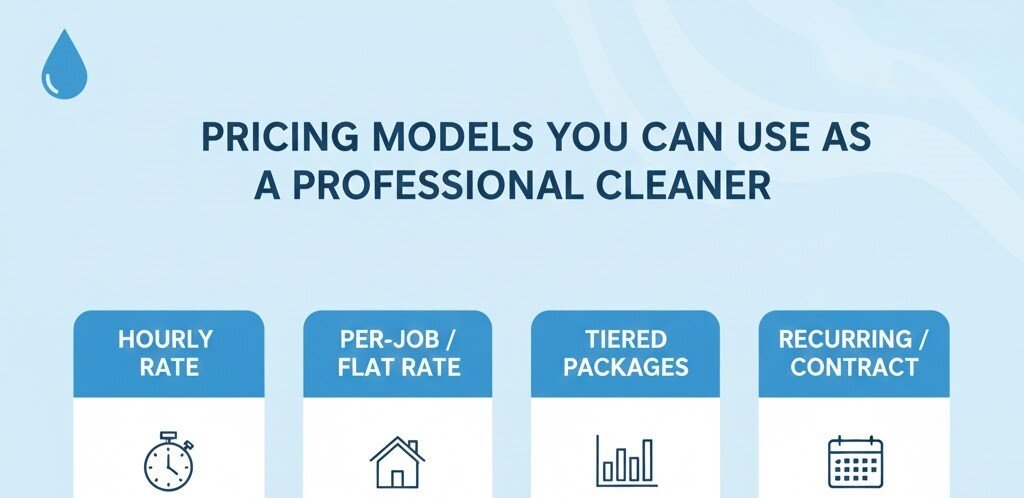
There’s no single “correct” way to charge for window cleaning. The right pricing model depends on your route type, the tools you use, customer frequency, and how you want to scale your business.
Most established professionals use a combination of these models to stay competitive while protecting their profit margins.
Here are the most reliable pricing models used across the industry.
Per Job Pricing (Most Common for Residential Work)
This is the simplest and most widely used model for domestic homes.
You quote one clear price for the entire property based on:
- Size of the home
- Amount of glass
- Ease of access
- First clean vs maintenance clean
- Height or tricky angles
Why this model works well:
- Easy for customers to understand
- Faster quoting
- Predictable earnings
- Works well with route-based scheduling
Per-job pricing pairs perfectly with WFP setups, as you can complete standard homes faster while maintaining strong profit margins.
Per Window Pricing (Useful for Uniform or High-Volume Properties)
This model is ideal when buildings have many identical panes or when clients want a clear breakdown.
Used for:
- Shopfronts
- Offices
- Schools
- Apartment blocks
- Commercial interiors
Advantages:
- Extremely transparent for clients
- Great for multi-window commercial spaces
- Easy to justify higher fees for high-reach or oversized panes
Professionals typically adjust pricing by window size, height, and accessibility.
Per Hour Pricing (Good for Internal Work or Complex Jobs)
While not usually advertised publicly, hourly pricing works well when:
- The scope is unclear
- The building is very large
- You’re handling interior glass
- Construction or builder cleans are involved
- The client wants fast, flexible labour
Why this works:
- Protects you from time-consuming surprises
- Ensures profitability on unpredictable jobs
- Allows accurate billing for multi-area cleans
Professional hourly earnings usually sit between £30–£50+ depending on method and efficiency.
Per Building or Per Floor Pricing (Commercial Contracts)
For commercial and multi-storey properties, many professionals switch to flat-rate building pricing, such as:
- Per floor
- Per block
- Per side of building
- Per frontage area
This model is ideal for:
- Offices
- Residential blocks
- Hotels
- Car dealerships
- Large retail units
Fixed building pricing provides clarity to both client and cleaner — and works especially well for all-year contracts.
Contract-Based Pricing (Recurring Revenue Model)
The most profitable and stable model for professional cleaners.
Contracts typically include:
- Weekly shopfront cleans
- Monthly commercial cleans
- 6–8 week residential schedules
- Quarterly block cleaning
- Annual exterior cleaning packages
Benefits:
- Consistent income
- Predictable routes
- Better time management
- Long-term customer retention
- Stronger business valuation
Many professionals offer slightly lower per-visit pricing for contract clients because long-term consistency increases annual revenue.
Mixed Pricing (Recommended for Most Professionals)
The most successful window cleaners don’t stick to a single pricing model — they combine them.
Typical mixed approach:
- Per job for residential
- Per window for offices and shops
- Per building or per floor for commercial units
- Contract-based for repeat clients
- Hourly for interior or complex one-off work
This flexibility ensures every job is profitable, regardless of size, access, or frequency.
Add-On Services — How They Change Your Rates
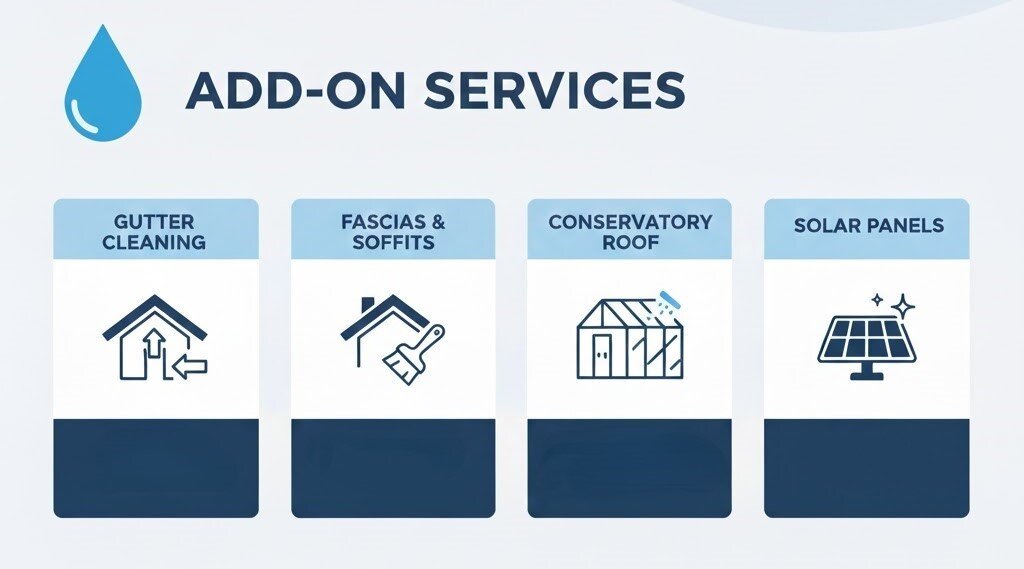
Add-on services are one of the easiest ways to increase your income without adding new customers. These extras require minimal extra time (especially with WFP systems), yet they significantly boost job value. Most professionals build add-ons into their quoting process because they improve profitability and set clear expectations for clients.
Below are the most common add-on services and how they influence pricing.
Frames, Sills & Doors
Frames and sills accumulate dirt faster than glass. While many cleaners include a light wipe as part of routine maintenance, detailed cleaning takes more time — especially on first cleans.
Impact on Pricing:
- First clean surcharge is higher when frames and sills require restoration
- Maintenance cleans may include a small +£2–£5 depending on the property
- WFP brushes make this extremely fast, improving hourly earnings
Frames and sills are often the customer’s first impression, so cleaners can confidently charge more for thorough detailing.
Gutter Cleaning
Gutter cleaning is a high-value service with strong profit margins.
Why it affects pricing:
- Often requires separate tools (vac systems or ladders)
- Takes longer and involves more debris removal
- Higher demand during specific seasons
- Adds significant value to the customer
Typical Add-On Range:
£30–£80+ depending on property size
Gutter cleaning is an excellent upsell for WFP operators because you’re already on-site.
Solar Panel Cleaning
Solar panels require purified water for streak-free cleaning, making WFP systems the ideal method.
Impact on Pricing:
- High-reach poles make the job easy
- Pure water guarantees a spotless finish
- Commercial sites pay premium rates
- Residential panels often need annual cleaning
Typical Add-On Range:
£20–£50+ for residential panels
Commercial pricing varies widely.
Fascia & Soffit Cleaning
These surfaces collect algae, grime, and mould — and customers often request them during first cleans or seasonal deep cleans.
Impact on Pricing:
- Requires more agitation and pure water
- Takes longer than a standard window clean
- Improves property appearance massively
Typical Add-On Range:
£20–£80+ depending on frontage size
WFP systems make these difficult areas safer and faster to clean.
Conservatory Roof Cleaning
Conservatory roofs involve multiple angled panels, plastic frames, and often difficult access.
Why this add-on has premium value:
- Difficult for customers to clean themselves
- WFP poles make access safe and straightforward
- Requires extra time for rinsing
- Ideal pairing with a full residential clean
Typical Add-On Range:
£20–£60+ depending on size
This is one of the most profitable residential extras.
Hard-to-Reach or Specialist Extras
Certain jobs require more skill, specialised tools, or additional time:
- Skylights / Velux windows
- Roof lanterns
- Dormer windows
- Balcony glass
- Internal stairway glass
- Glass balustrades
These usually add £5–£20+ depending on complexity.
Signs You’re Undercharging (Most Professionals Don’t Realise These)
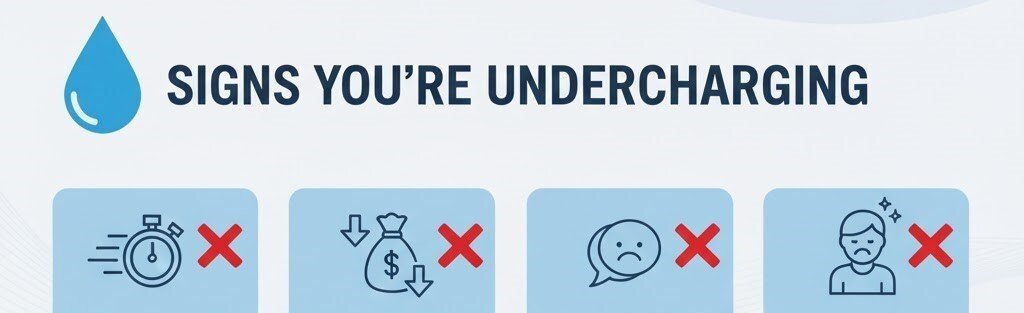
Many window cleaners stay busy but never see real profit because their prices are too low. Undercharging doesn’t just affect income — it affects growth, equipment investment, route quality, and long-term business sustainability.
Here are the most common signs that your prices need to increase.
You’re Fully Booked But Not Earning Enough
If you work long hours yet still struggle to reach your target income, it means:
- Your rates are below market
- Your hourly earnings are too low
- Your equipment efficiency isn’t reflected in your pricing
A full schedule should be a sign of success — not exhaustion.
If you’re fully booked, but income feels tight, your pricing is too low.
You Have Too Many One-Off Jobs
One-off jobs take much longer and often require more effort.
If your schedule is filled with irregular customers, it means you’re underpricing maintenance routes.
Professionals prioritise repeat customers because they:
- Take less time
- Are more predictable
- Improve route efficiency
- Provide stable income
Cheap prices attract one-offs — strong pricing builds regular clientele.
You Feel You Must Match Local Competitors
Matching local cleaners is a recipe for undercharging.
Why?
- Their prices might be outdated
- They may not use efficient WFP systems
- They may be undercharging themselves
- Their business model might be different from yours
- Their quality or professionalism may be lower
Your pricing should reflect your efficiency and your equipment, not someone else’s numbers.
Travel Time Eats Into Your Profit
If a 15–20 minute job becomes a 45-minute round trip, your pricing isn’t balanced.
Travel time must be included in your rates — otherwise:
- Fuel costs eat margins
- Longer routes become unprofitable
- Jobs outside your main route cost more than they earn
A common sign of undercharging:
You hesitate to remove distant customers because they still “seem” worth keeping — even though they aren’t.
You Haven’t Raised Prices in 12 Months
Prices rise annually across every trade.
If your rates haven’t increased in a year, your profit margin is shrinking without you noticing.
Professionals typically:
- Review pricing yearly
- Adjust based on fuel and consumables
- Consider route demand
- Raise prices when fully booked
If you haven’t reviewed or raised prices lately, you’re likely undercharging.
You Regularly Skip Frame or Sill Work Because It Takes Too Long
If you avoid frames or sills because the job becomes “not worth the price,” that is a clear sign your rates are too low.
Your price should always cover the full job, including:
- Frames
- Sills
- Doors
- High panes
- Access time
Skipping tasks due to low pricing = undercharging.
You Hesitate to Quote Higher Prices but Clients Accept Instantly
If every client says “yes” to your price without hesitation, your rate is too low.
Professionals know that:
- A 10–20% challenge rate is normal
- Instant acceptance means price is below market
- “Too cheap” is worse for business than “slightly premium”
If nobody ever questions your price, you’re undervaluing your service.
Tips to Increase Your Rates Without Losing Customers
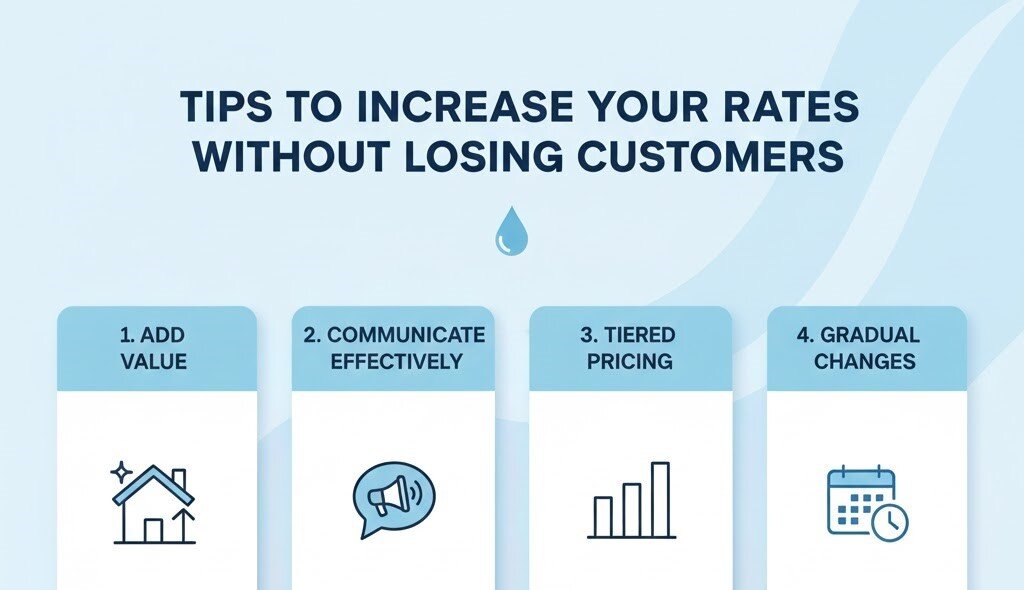
Raising prices can feel uncomfortable, but it’s a normal and healthy part of running a professional window cleaning business. When done correctly, most customers accept the change — especially when they see consistent results and a reliable service.
Here are proven ways professionals increase their rates while maintaining strong customer relationships.
Improve Efficiency with Better WFP Setups
Speed and consistency are two of the biggest reasons customers stay loyal.
Upgrading your equipment helps you:
- Finish jobs faster
- Deliver streak-free results
- Handle high or awkward windows safely
- Maintain predictable schedules
When your service becomes noticeably smoother and more reliable, a small price increase feels justified.
Efficiency upgrades include:
- Electric hose reels
- Larger tank capacity
- High-quality brushes
- RO/DI-based pure water systems
- Better flow controllers
Improved efficiency = improved earning power.
Offer Maintenance Schedules Instead of One-Off Services
Customers value consistency.
Instead of quoting each job individually, offer:
- Monthly cleaning
- 6–8 week cycles
- Fortnightly shop cleans
- Quarterly commercial contracts
Maintenance schedules help you:
- Build predictable income
- Improve route planning
- Reduce time wasted on one-off jobs
- Justify premium pricing through reliability
Most customers are willing to pay more for guaranteed, regular service.
Improve Your Professional Presentation
Customers associate higher prices with higher professionalism.
Simple improvements make a big difference:
- Clean van with visible branding
- Professional clothing or uniform
- Clear communication before visits
- Neat hose management (especially with electric reels)
- Accurate arrival times
- Friendly, reliable customer interaction
When your service feels premium, your pricing can reflect it.
Use Simple Customer Communication Templates
How you present your price increase matters more than the increase itself.
A professional template may include:
- A thank-you message
- A brief explanation (fuel costs, consumables, time)
- The new price
- The date it takes effect
- Appreciation for continued loyalty
Example outline:
“Due to rising operating costs and increased demand, our updated price for your regular clean will be £XX from [date]. We remain committed to providing reliable, high-quality service and appreciate your continued support.”
Clear, polite communication makes price updates smooth and stress-free.
Focus on Value, Not Just Price
Customers stay because of:
- Reliability
- Speed
- Quality
- Consistency
- Trust
If you deliver excellent results — especially using a WFP system — a modest price increase will not affect customer retention.
The key is to remind customers of the value they receive:
- Safer work
- Better reach
- Cleaner results
- No ladders
- Quicker appointments
- Pure-water finish
When your value is strong, price becomes secondary.
Tools & Equipment You’ll Need to Price Jobs Correctly
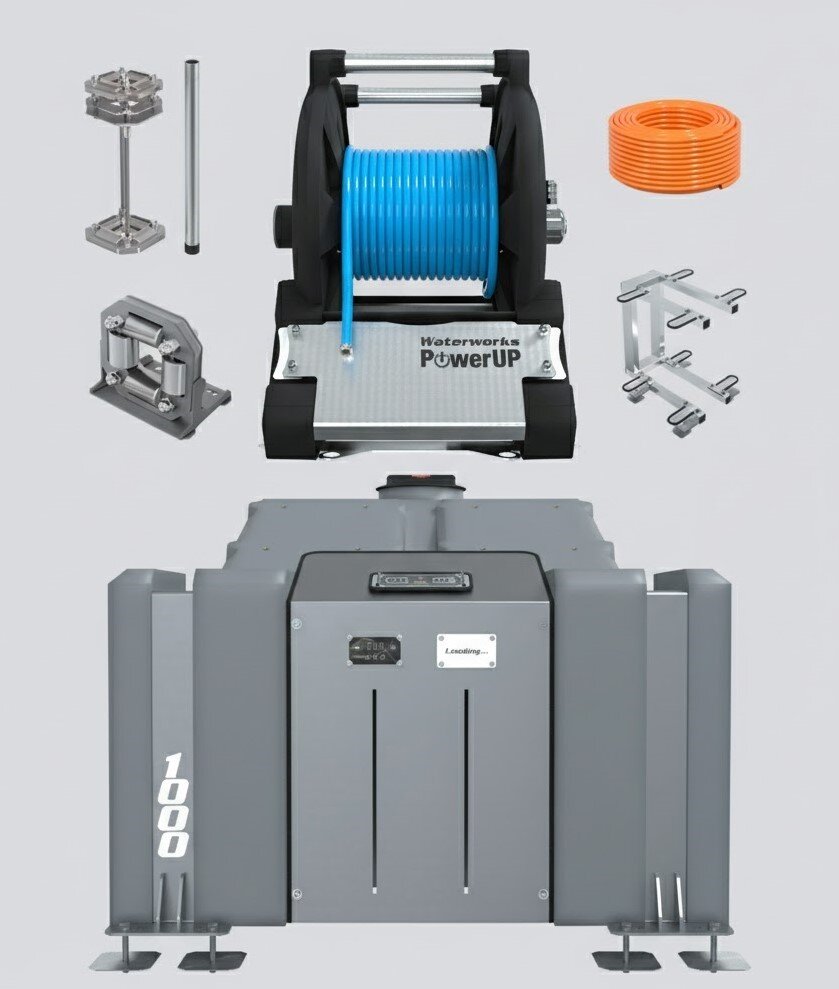
Accurate pricing starts with understanding the tools required for each job. The right equipment doesn’t just improve cleaning speed — it helps you predict job time, assess difficulty, and calculate pricing with confidence.
Professionals use a combination of traditional and pure-water tools to stay flexible across domestic and commercial routes.
Here are the key pieces of equipment that directly influence both job efficiency and pricing accuracy.
Poles (Traditional & Water-Fed)
Poles determine your reach, your speed, and the types of properties you can clean.
Traditional Poles:
- Effective for lower windows
- Used with squeegees and applicators
- Require more physical effort
- Limited reach above ground floor
Water-Fed Poles (WFP):
- Clean at height safely from the ground
- Faster for repeat domestic routes
- Ideal for commercial glass
- Work with pure water for streak-free results
Why this affects pricing:
The more windows you can reach quickly, the more accurately you can quote jobs — especially on multi-storey properties.
Hose Reels (Manual or Electric)
Reels play a big role in job timing and overall workflow.
Manual Reels:
- Budget-friendly
- Slower to pack down
- Best for small to medium routes
Electric Reels:
- Rapid deployment and rewind
- Save 30–60 minutes per day
- Essential for high-volume residential or commercial routes
Why this affects pricing:
You can quote confidently when you know how long setup/pack-down will take for each job.
RO/DI Systems
Pure-water systems (reverse osmosis + deionising) produce high-quality purified water that dries without leaving marks.
RO/DI Systems Provide:
- Consistent cleaning results
- Faster rinsing
- Fewer repeat passes
- Higher customer satisfaction
- Lower long-term costs compared to DI-only
Why this affects pricing:
You can accurately estimate job time because your finishing quality is consistent — even on problem glass.
DI-Only Systems
DI-only systems are excellent for areas with low TDS (water hardness).
Benefits:
- Compact
- Simple
- Low maintenance
- Great for small routes or beginners
Considerations:
Resin costs increase in hard-water areas.
Why this affects pricing:
Knowing your resin usage helps you include consumable cost accurately in your pricing formula.
Accessories & Maintenance Tools
Every professional relies on small accessories that make cleaning faster and more efficient:
- Brushes (soft, medium, flocked, sill brushes)
- Connectors & hose fittings
- Flow controllers
- Nozzles & jets
- Squeegees & applicators
- Scrub pads
- TDS meters
Why this affects pricing:
When you know your exact setup and tool efficiency, you can quote confidently without undervaluing your time.
Safety & Efficiency Equipment
Pricing accuracy improves when your workflow is predictable.
Key tools include:
- Pump controllers
- Secure tank mounting solutions
- Pole clamps and upgrades
- Stable van layout
- Battery systems for pumps and reels
Why this affects pricing:
A stable, efficient setup ensures repeat cleans take the same amount of time, allowing consistent, predictable pricing.
Frequently Asked Questions — Pricing for Window Cleaners

These are the most common questions professionals ask when deciding how much to charge for window cleaning. Each answer is based on real industry averages and practical experience.
Should I charge per window or per job?
Both models work, but they suit different situations.
- Per job: Best for residential properties where quoting by property size is simpler and faster.
- Per window: Ideal for commercial buildings, shopfronts, or interiors where panes are uniform and easy to count.
Most professionals use per-job pricing for domestic routes and per-window pricing for commercial projects.
How often should I increase my rates?
Most professionals review and adjust their pricing once every 12 months.
This ensures your rates stay aligned with:
- Fuel and consumable costs
- Inflation
- Demand in your service area
- Your efficiency improvements
If you’ve upgraded your equipment or become faster, your pricing should reflect the added value.
Should I charge extra for first cleans?
Yes — always.
First cleans take 2–3 times longer because frames, sills, and glass need deeper cleaning.
A typical first-clean surcharge is 30%–60%, depending on condition.
Maintenance cleans are faster and can be priced lower without affecting your hourly earnings.
How do I price commercial jobs?
Commercial work is usually priced differently from residential work.
Most cleaners charge:
- Per frontage (for shopfronts)
- Per building (for offices)
- Per contract (monthly/quarterly cleans)
Commercial pricing takes into account:
- Access difficulty
- Number of panes
- Height
- Cleaning frequency
- Out-of-hours access
Because schedules are predictable, commercial routes often produce higher long-term income.
What if the customer thinks my price is too high?
A small percentage of customers will always look for the cheapest option.
This doesn’t mean your price is wrong.
Professionals usually explain:
- The difference in cleaning quality (pure water vs traditional)
- Safety benefits of WFP work
- Reliability and consistency
- Time savings
- Damage-free high-reach cleaning
- Included extras (frames, sills, doors, etc.)
If a customer still declines, they were not the right fit for your business.
Is water-fed pole cleaning more expensive for customers?
Not necessarily — but it can be priced at a premium because it offers:
- Better reach
- Safer working conditions
- Faster cleaning cycles
- Spot-free, chemical-free finish
- Better results on high and awkward windows
Even when the customer pays the same price as traditional cleaning, the cleaner’s hourly earnings are higher due to speed and efficiency.
Final Pricing Checklist for Window Cleaners
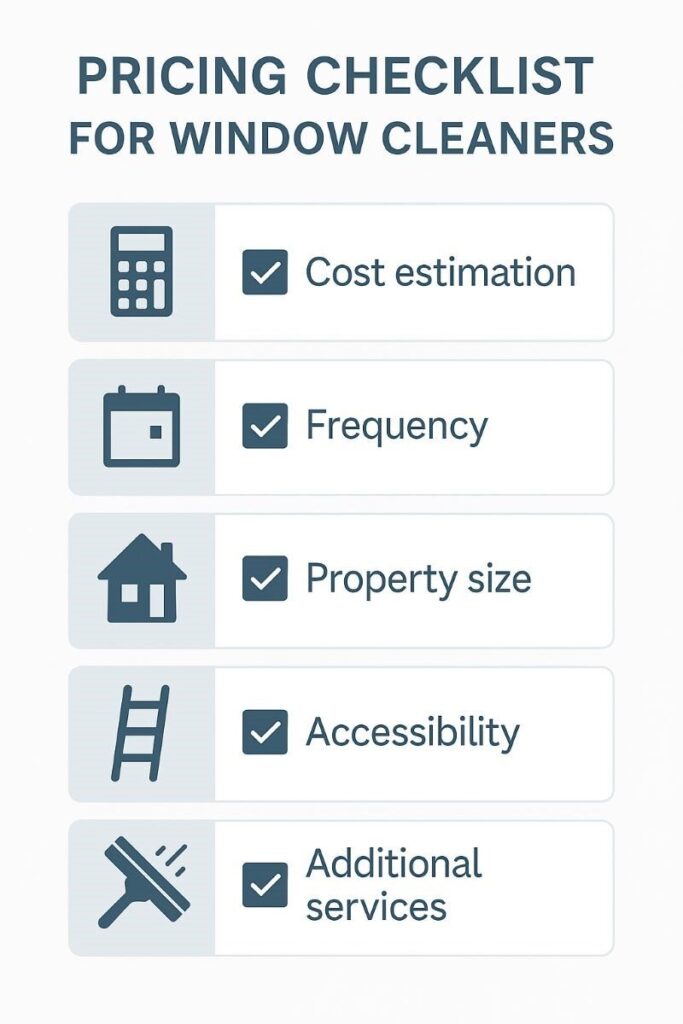
Use this checklist to make sure every quote you give is fair, consistent, and profitable.
Professional cleaners rely on these points to avoid undercharging and to price confidently on every job.
Pricing Formula Summary
Before quoting, confirm you’ve calculated:
- Your base cost per job (fuel + consumables + time)
- Your labour value (per-minute or per-hour target)
- A profit margin that supports long-term growth
- A first-clean surcharge if required
- A realistic maintenance price for regular routes
If all five are covered, your price will naturally be competitive and profitable.
Rate Ranges Summary
Keep these industry benchmarks in mind:
- Small homes: £10–£20
- 2–3 bed homes: £20–£40
- Larger homes: £40–£70+
- Shopfronts: £10–£25 (per clean)
- Commercial units: £40–£80+
- Per-window: £1–£8 depending on size & height
- Hourly earning potential: £30–£50+ with WFP systems
These aren’t rules — they’re starting points for confident quoting.
Efficiency Tools Checklist
Your equipment influences both job time and earning potential.
Make sure your setup is reliable and efficient:
- Van-mounted WFP system (500L/750L/1000L)
- Manual or electric hose reel
- Strong pump and flow controller
- High-quality brushes
- RO/DI or DI-only system
- Clean poles with secure clamps
- Organised van layout
- Working TDS meter
Efficient equipment = faster work = higher earnings per hour.
When to Review and Update Your Prices
Professionals typically adjust prices when:
- Demand increases
- Routes become fully booked
- Fuel and consumables rise in cost
- You upgrade equipment and deliver faster results
- You haven’t updated pricing in 12 months
- Certain jobs consistently take longer than expected
Small, consistent adjustments are better than large reactive ones.
Ready to Increase Your Earnings With a More Efficient Setup?

If you want to charge confidently and increase your earning potential, the right equipment plays a major role. Faster setup times, higher reach, pure-water consistency, and reliable flow control all help you complete more jobs per day — without lowering your prices.
Whether you’re upgrading your existing system or building a new one from scratch, Waterworks offers high-quality tools that help professionals clean faster, work safer, and grow their business with confidence.
Explore the most popular options for professional cleaners:
- Build Your Custom Window Cleaning System Create a system tailored to your route, water source, and workflow.
- Manual & Electric Hose Reels Choose between fast manual reels or time-saving electric reels for high-density routes.
- RO/DI Pure Water Systems Produce consistently pure water for streak-free finishes on every job.
- DI-Only Systems for Lower TDS Areas Compact, simple, and perfect for new cleaners or small routes.
Upgrading your equipment isn’t just about improving quality — it’s about improving your efficiency, increasing your hourly earnings, and giving your customers the professional results they expect.
Conclusion
Setting the right price for window cleaning isn’t guesswork — it’s a combination of understanding your costs, choosing the right pricing model, and using efficient tools that help you deliver consistent results. By applying the professional formulas, benchmarks, and examples in this guide, you can charge confidently, protect your profit margins, and grow your business sustainably.
With a modern pure-water system, faster setup, and reliable equipment, you can complete more work per day while offering customers a safer, higher-quality service.
Whether you’re just starting or refining your pricing structure, the right approach — and the right setup — will help you earn more with every clean.