
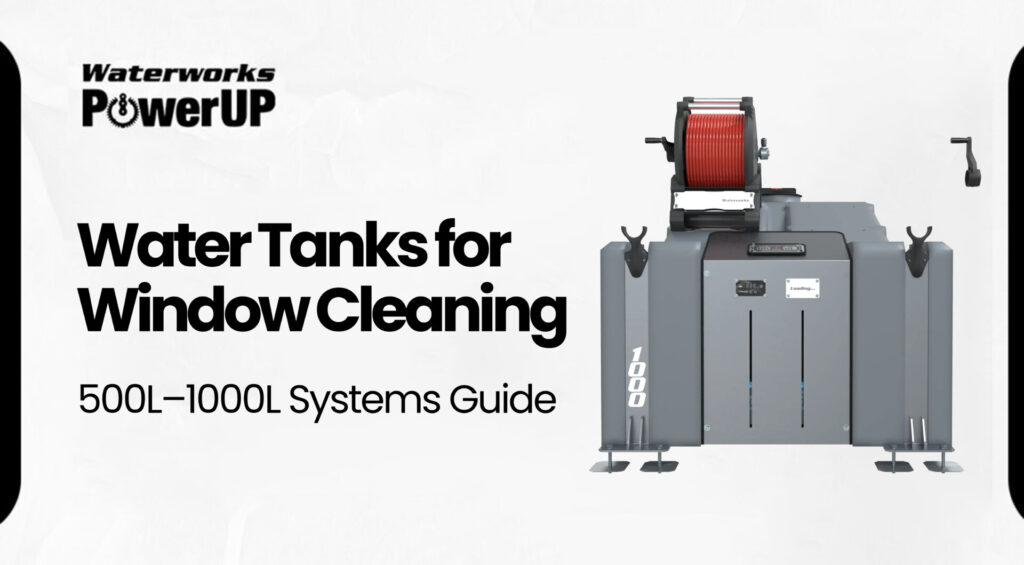
Window cleaning tanks store purified water for daily water-fed pole work and come in 500L, 750L and 1000L sizes depending on your van and workload. Waterworks tank systems offer durable polyethylene construction, stainless steel frames, tank-mounted reels and built-in fixing points for pumps and controllers to create a compact, professional installation.
Key Facts
- 500L, 750L & 1000L Options — Suitable for small, medium and large vans.
- Durable Polyethylene Tanks — Designed for long-term daily use in mobile setups.
- Stainless Steel Frame & Door — Rust-resistant, strong and built for secure mounting.
- Tank-Mounted Reels — Saves valuable floor space and keeps the van organised.
- Built-In Fixing Points — Easy mounting for pumps, controllers and Victron chargers.
- DIY-Friendly Design — Fast installation with simple upgrade paths for growing businesses.
- Professional Layout — Neat, ergonomic and efficient for one-man or two-man setups.
- Space-Saving System — Compact footprint ideal for busy window cleaners needing workflow efficiency.
In This Article
What Is a Window Cleaning Water Tank?
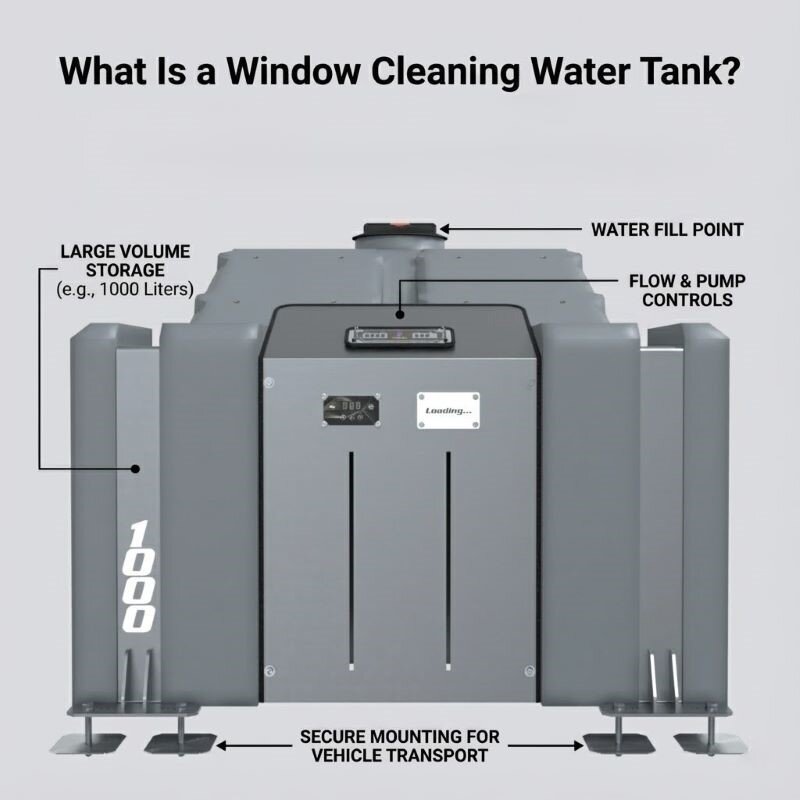
A window cleaning water tank is the core of any professional water-fed pole (WFP) system. It stores the purified water you use throughout the day, feeds your pump and controller, and delivers a consistent supply of water to your hose reel and pole — allowing you to work efficiently without constant refills.
Instead of relying on small containers or makeshift DIY setups, cleaners use professionally moulded polyethylene tanks because they’re purpose-built for mobile use, durable, and designed to handle the daily movement of water inside a van.
For professional window cleaners, the tank isn’t “just a container.”
It’s the foundation that determines:
- How long you can work without refilling
- How smoothly your pump performs
- How well-balanced your van stays
- How organised and efficient your setup feels
- How safely your equipment stays secured
A well-designed tank makes your workday easier, faster, and more reliable.
How a Water Tank Works Inside a Water-Fed Pole System
A complete WFP setup follows a simple flow:
Tank → Pump → Controller → Hose Reel → Water Fed Pole → Brush Head
Each stage depends on the tank performing properly:
- Tank: Holds clean water for the day
- Pump: Draws water smoothly from the tank
- Controller: Regulates water flow and pressure
- Hose Reel: Delivers water to your pole
- Pole & Brush: Cleans glass using purified water
When the tank is stable, mounted correctly, and installed with a proper frame, everything else works better:
- Pumps last longer
- Flow remains consistent
- There’s less strain on components
- System is easier to manage and maintain
- Your van stays tidy and professional
This is why Waterworks tanks include built-in fixing points for pumps, controllers, chargers and PowerUP reels — giving you a cleaner, safer installation without drilling into the tank or van flooring.
Why a Professionally Designed Tank Improves Safety & Stability
When you carry 500–1000 litres of water inside a van, stability matters.
A high-quality tank is designed to minimise water movement, distribute weight safely, and remain secure during day-to-day driving — especially when braking, accelerating or turning.
A professional tank system helps:
- Keep the van balanced and predictable
- Reduce water surge inside the tank
- Protect equipment from shifting
- Maintain safe weight distribution over the axle
- Improve overall vehicle handling
Cheap DIY containers or IBC tanks aren’t built for driving environments and can:
- Shift during transit
- Create heavy water movement
- Damage pumps
- Stress the chassis
- Lead to unsafe braking
Using a professionally designed tank system — like the Waterworks 500L, 750L or 1000L Tank, Frame & Door Platforms — ensures your setup stays secure, stable and built for real working conditions.
What Makes a Good Window Cleaning Tank? (Materials, Build & Design)

A professional window cleaning tank must handle daily use, constant water movement, and the demands of mobile work. The right materials and design directly affect safety, durability and the overall performance of your water-fed pole system.
Below is a simple, practical breakdown to help you understand what matters — without confusing technical jargon.
Tank Material: Why Polyethylene Is the Industry Standard
Most professional window cleaning tanks — including the Waterworks 500L, 750L and 1000L systems — are built from high-quality polyethylene.
Polyethylene is preferred because it is:
- ✔ Strong and impact-resistant
- ✔ Durable for long-term daily use
- ✔ Lightweight compared to metal tanks
- ✔ Safe for purified water storage
- ✔ Weather-resistant for UK conditions
While many materials could theoretically hold water, polyethylene is the only practical, reliable and cost-effective option for mobile window cleaning systems.
This is why nearly every trusted UK system manufacturer uses it.
Why Stainless Steel Frames Matter
The frame underneath the tank is just as important as the tank itself.
A tank full of water becomes extremely heavy, and a weak frame can:
- Twist or bend
- Rust and weaken over time
- Cause the tank to shift
- Damage the van’s floor
- Create safety issues while braking
Waterworks uses stainless steel frames, which offer major advantages:
- ✔ No rust — stays clean and professional
- ✔ Very strong under high weight
- ✔ Long-lasting and low-maintenance
- ✔ Ideal for both DIY and professional installations
- ✔ Better resale value of both the equipment and van
Competitors often use powder-coated steel, which can chip, corrode or wear down.
Stainless steel is the superior option for longevity and safety.
Stainless Steel Doors for Better Mounting & Upgrade Options
Each Waterworks Tank, Frame & Door Platform includes a stainless steel door with laser-cut mounting points.
This gives you:
- ✔ A clean, organised layout
- ✔ Proper mounting for pumps, controllers and chargers
- ✔ Space to expand your system later
- ✔ A professional finish inside the van
- ✔ Better airflow and cable management
Essentially, the door works like a built-in control panel — helping keep wires, pumps and components neat and accessible.
Why Purpose-Built Designs Outperform DIY Containers
A purpose-made window cleaning tank system offers benefits that DIY barrels or IBC tanks can’t match:
| Feature | Professional Tank | DIY/IBC Containers |
| Designed for Mobile Use | ✔ Yes | ❌ No |
| Stable Under Braking | ✔ Safe | ❌ Risky |
| Clean Installation Options | ✔ Built-in fixing points | ❌ None |
| Long-term Durability | ✔ High | ❌ Low |
| Professional Appearance | ✔ Clean | ❌ Untidy |
| Space Efficiency | ✔ Excellent | ❌ Poor |
A purpose-built tank doesn’t just store water —
it makes your entire system safer, cleaner and more efficient.
How Waterworks Tanks Improve Space & Workflow
Waterworks tanks are engineered with built-in mounting locations for key components, allowing you to:
- Mount your reels directly onto the tank
- Free up floor space
- Keep pumps & controllers in a neat control area
- Maintain a clean, ergonomic van layout
- Create faster workflow for daily jobs
This is one of the biggest reasons professionals upgrade from DIY systems —
your van becomes a more organised, easier-to-work-in environment.
500L vs 750L vs 1000L – Which Tank Size Do You Need?
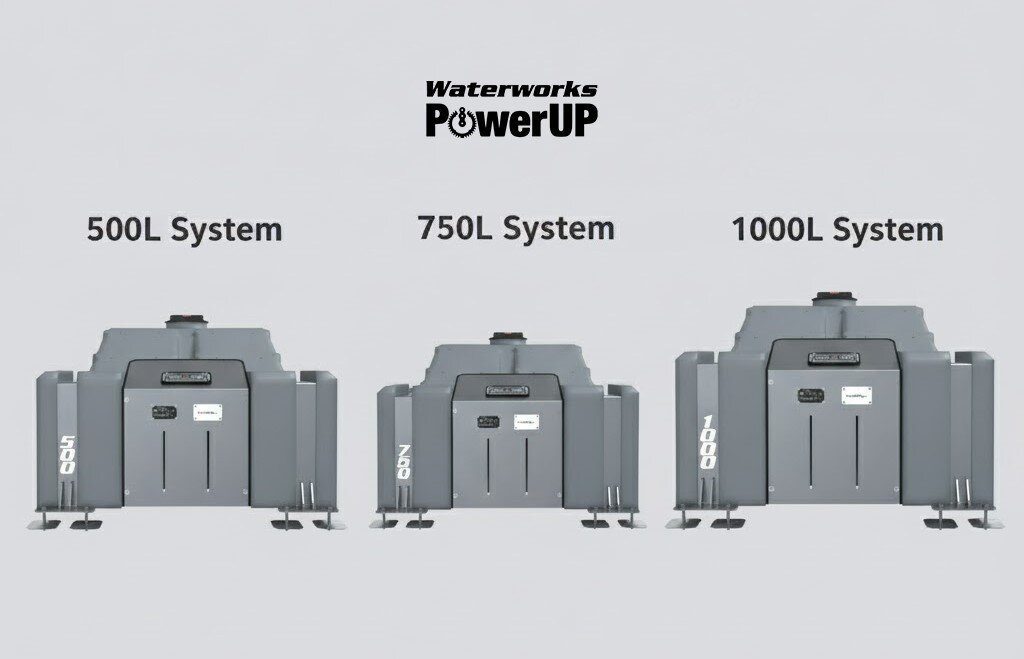
Choosing the right tank size is one of the most important decisions for any window cleaner — because it directly affects how long you can work, how your van handles, and how smoothly your daily workflow runs.
Waterworks offers three professional tank sizes designed for different types of cleaners, vans and routes.
Here’s a clear, real-world breakdown to help you choose the perfect one.
Quick Comparison Table — At a Glance
| Feature | 500L Tank | 750L Tank | 1000L Tank |
| Ideal For | Domestic work | Mixed domestic + commercial | Heavy commercial |
| Operators | 1–2 | 1–2 | 1–2 |
| Average Runtime | 3–5 hours | 5–7 hours | 7–10 hours |
| Best Van Size | Small vans | Medium vans | Large vans |
| Weight (Empty) | 75 KG | 85 KG | 95 KG |
| Best Choice If You… | Compact & lightweight setup | More range without losing space | Maximum daily capacity |
(Note: Runtime varies depending on flow rate & job type.)
500L Tank — Best for Small Vans & Solo Cleaners
The 500L system is perfect for:
- Solo window cleaners
- Domestic-heavy routes
- Smaller vans (Berlingo, Caddy, Partner)
- Those upgrading from DIY setups
- Cleaners who want a compact, lightweight system
Why choose 500L?
- ✔ Very efficient for residential work
- ✔ Lightest and easiest to manage
- ✔ Fits comfortably in small vans
- ✔ Perfect balance of size + performance
- ✔ Lower running costs and fuel impact
If your work rarely exceeds 5 hours of continuous cleaning, 500L is more than enough.
750L Tank — The Balanced Choice for Most Professionals
The 750L system is the most popular choice for cleaners who need capacity without compromising space.
Best suited for:
- Cleaners doing mixed domestic + commercial work
- Operators who work 5–7 hour routes
- One or two-man teams sharing a van
- Medium vans like Transit Custom, Vivaro, Transporter
Why choose 750L?
- ✔ Excellent balance of weight, space & runtime
- ✔ Enough water for long domestic routes
- ✔ Handles small-to-medium commercial jobs
- ✔ Still compact and van-friendly
- ✔ Ideal upgrade from 500L when workload increases
If you want both capacity and space efficiency, 750L hits the sweet spot.
1000L Tank — Maximum Capacity for the Busiest Cleaners
The 1000L system is designed for professionals who need to carry the highest amount of water possible.
Best for:
- Commercial routes
- Large vans (Transit, Master, Sprinter)
- Two-man operations
- Long days with no refill options
- High-demand areas or multiple contracts
Why choose 1000L?
- ✔ Maximum runtime (up to 10 hours depending on usage)
- ✔ Reduced need to refill mid-day
- ✔ Perfect for big vans and commercial sites
- ✔ Great for scaling to larger workloads
- ✔ More water = more earning potential per day
If your van size allows and you regularly do big jobs, 1000L gives you the freedom to work all day efficiently.
Which Tank Is Best for Your Van?
| Van Size | Recommended Tank |
| Small vans (Berlingo, Caddy, Partner) | 500L |
| Medium vans (Transit Custom, Vivaro, Transporter) | 750L |
| Large vans (Transit, Master, Sprinter) | 1000L |
Choosing the correct size ensures:
- Stable driving
- Proper weight distribution
- Better fuel efficiency
- Safer braking
- Smooth daily workflow
Real-World Examples — Which Tank Is Right for Your Type of Work?

Every window cleaner’s route, workload and van setup is different.
Instead of guessing which tank size is right, use these simple real-world scenarios to match your daily work with the ideal Waterworks system.
Example 1 — Solo Domestic Cleaner Using a 500L System
Profile:
- 1-person operation
- Mostly residential houses
- Compact van: Berlingo, Caddy, Partner
- Average working time: 3–5 hours per day
- Limited van space, wants easy manoeuvrability
Why 500L is the perfect match:
- ✔ Lightweight and easiest to manage
- ✔ Enough water for a full domestic route
- ✔ Fits small vans without compromising safety
- ✔ Saves fuel and keeps the van agile
- ✔ Ideal upgrade from DIY or jerry-can setups
Who this suits:
New cleaners, solo operators, domestic-focused cleaners, and anyone needing a compact professional setup.
Example 2 — Mixed Domestic + Commercial Cleaner Using a 750L System
Profile:
- Mix of houses + small commercial jobs
- Sometimes works solo, sometimes with a helper
- Uses a medium van: Transit Custom, Vivaro, Transporter
- Workdays typically 6–8 hours
- Needs more water without losing van space
Why 750L is the best fit:
- ✔ Great balance of size, weight and runtime
- ✔ Handles bigger days without mid-day refills
- ✔ Enough capacity for two operators on mixed routes
- ✔ Compact enough to keep van layout clean and organised
- ✔ Most efficient upgrade for growing cleaners
Who this suits:
Busy solo cleaners, 1–2 person teams, and cleaners expanding from residential into commercial work.
Example 3 — High-Demand Commercial Cleaner Using a 1000L System
Profile:
- Heavy commercial work
- Large contracts or multi-hour properties
- Two-man team in one van
- Large van: Transit, Master, Sprinter
- Workdays 8–10+ hours
- Needs maximum water without interruptions
Why 1000L is the top choice:
- ✔ Longest runtime (no refills)
- ✔ Perfect for full-day commercial routes
- ✔ Ideal for businesses servicing offices, schools, hotels, etc.
- ✔ Supports two operators continuously
- ✔ Highest earning potential due to uninterrupted workflow
Who this suits:
Established companies, two-man teams, and cleaners working long days with no refill access.
Cost Breakdown — What Goes Into a Professional Window Cleaning Tank System?
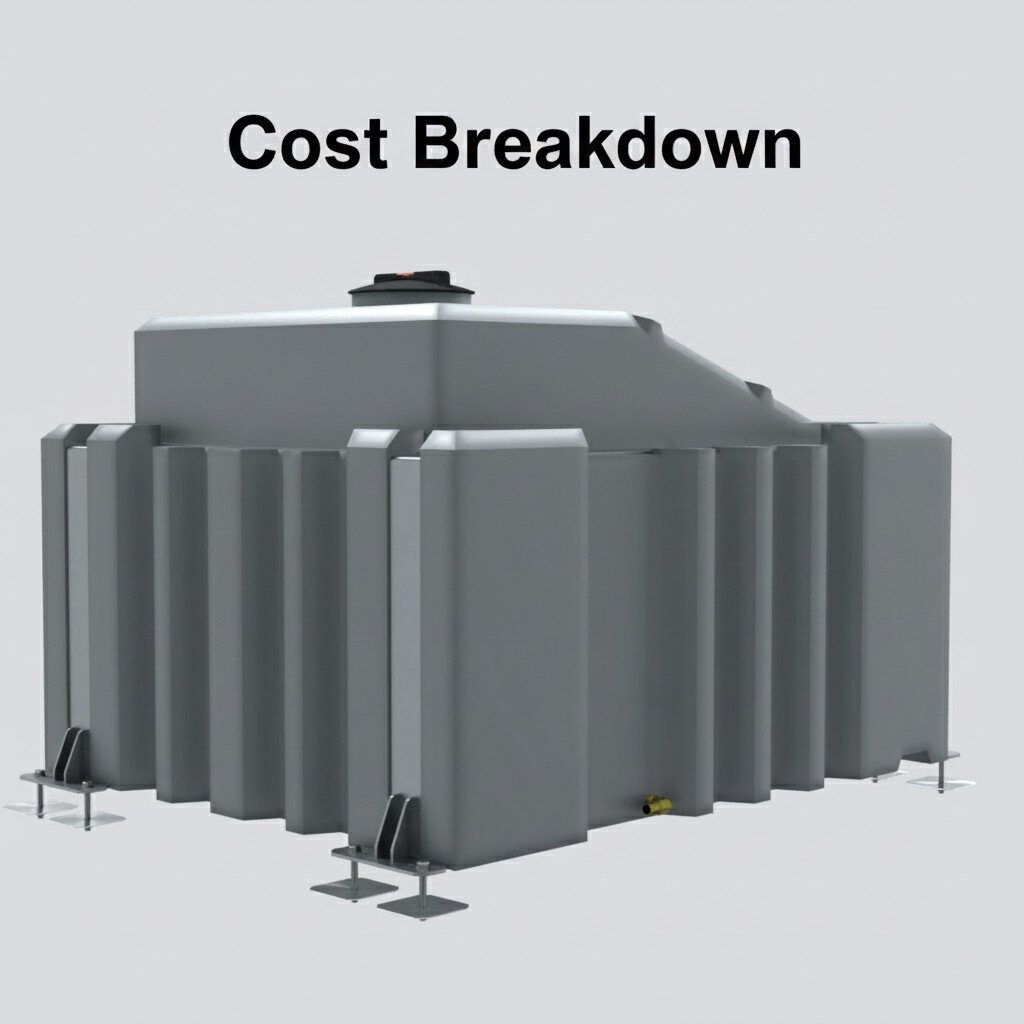
A window cleaning tank system isn’t just the tank.
It’s a combination of components that work together to create a safe, efficient and professional setup inside your van.
Understanding the cost breakdown helps you choose the right system for your needs — and avoid overspending on parts you don’t actually require.
1. Tank, Frame & Door Platform (Main Cost)
This is the foundation of your entire setup.
What you’re paying for:
- The tank (500L / 750L / 1000L)
- Stainless steel frame
- Stainless steel door with laser-cut mounting points
- Purpose-built design for pumps, controllers and reels
- Strong, reliable polyethylene construction
- Space-saving layout
- A professional looking, easy-to-maintain installation
These systems typically represent the largest part of the total cost, because they provide the structure required to safely carry hundreds of litres of water.
👉 Waterworks offers all three sizes at a competitive price point — ideal for both DIY builders and growing businesses.
2. Pumps, Controllers & Power Delivery
Your tank feeds the rest of your system, so stable pump flow is essential.
Common components include:
- 12V water pumps
- Digital flow controllers
- Strainers & fittings
- Battery or charging system (e.g., Victron B2B)
Cost varies depending on:
- Brand
- Flow rate
- Whether you prefer manual or digital control
- Whether you want a simple or fully automated setup
Waterworks tanks already include mounting points for these — saving installation time and reducing costs.
3. Hose Reels (Manual or Electric)
Reels make up a noticeable part of the total investment.
Two main options:
✔ Manual Reels
- Affordable
- Simple to use
- Reliable and low-maintenance
✔ PowerUP Electric Reels
- Faster, effortless operation
- Big time saver on large routes
- Perfect for busy cleaners or two-man teams
Waterworks tanks allow you to mount reels directly onto the tank, freeing up floor space and giving your van a cleaner layout.
This reduces the need for additional mounts or fabrication work.
4. Filtration (If You Purify Water Yourself)
If you produce pure water from home or in your van, you may also use:
- DI vessels
- RO systems
- Carbon filters
- Resin
- Boost pumps
These are optional costs — not part of the tank system itself.
Some cleaners buy pure water from suppliers, so they don’t need filtration equipment at all.
5. Installation & Fittings
If you’re upgrading from a DIY setup, you may already have many parts.
If not, installation costs can include:
- Hose fittings
- Electrical wiring
- Pump mounts
- Battery tie-downs
- Brackets and straps
- Labour (if using a professional installer)
Waterworks’ stainless steel platform reduces installation time because the tank, frame and door already include dedicated fixing points for pumps, controllers and chargers.
6. Operating Costs (Long-Term View)
A well-built tank system saves money over time by preventing:
- Frame rust
- Pump strain
- Leaks
- Excessive van wear
- Breakdowns
- Reinstallation costs
Choosing a reliable tank platform upfront is almost always cheaper than replacing or upgrading a DIY solution later.
How to Install a Window Cleaning Tank Safely in Your Van
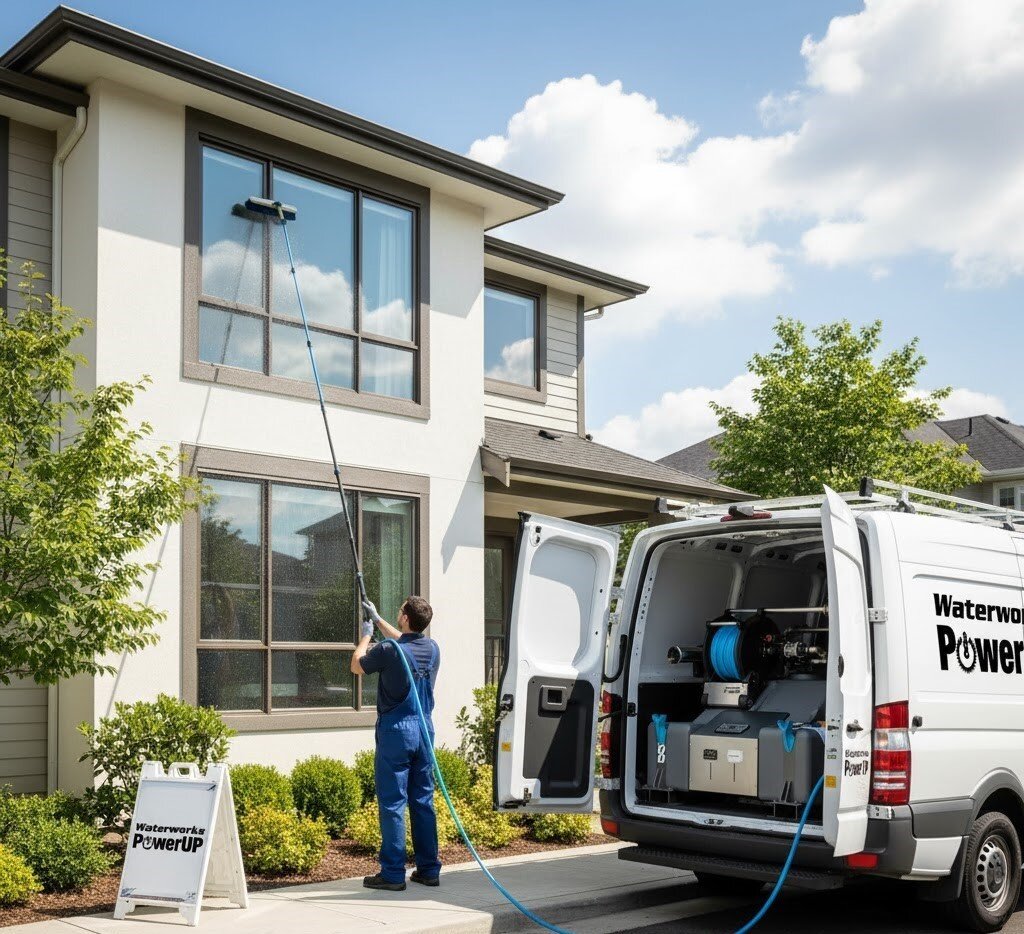
Installing a water tank correctly is just as important as choosing the right tank size.
A poorly secured system can affect van handling, damage equipment and create safety risks — while a proper installation keeps your setup professional, tidy and reliable.
Here’s what every window cleaner should know before installing a tank in their van.
Positioning the Tank Correctly Inside the Van
For the safest and most balanced setup, a tank should be positioned:
- As close to the centre of the van as possible
- Over or near the rear axle
- Against the bulkhead (when space allows)
- On a strong, level surface
Correct tank placement improves:
- ✔ Braking stability
- ✔ Weight distribution
- ✔ Van handling
- ✔ Fuel efficiency
- ✔ Overall comfort during driving
Waterworks tanks are designed with a flat base and frame that make positioning simple and secure.
Why the Frame Matters — Secure Mounting Prevents Shifting
The frame underneath your tank keeps hundreds of litres of water stable during driving.
A weak frame or poor installation can allow the tank to move, twist or put uneven stress on the van’s floor.
Waterworks tank systems use stainless steel frames, which offer:
- ✔ Strong, stable support
- ✔ Resistance to corrosion
- ✔ Clean and professional appearance
- ✔ Long-term durability
- ✔ Safer load distribution
This helps prevent tank movement and keeps your van compliant with basic load safety principles.
Safe Mounting: Using Bolts Instead of Straps
A common mistake in DIY setups is securing tanks with ratchet straps or rope.
This is unsafe, especially when the tank is full.
A professional installation should use:
- ✔ Bolted mounting points
- ✔ Anchoring through the frame
- ✔ Proper load-rated fixings
This ensures the tank stays firmly in place, even during sudden braking.
Waterworks platforms include pre-drilled holes on the frame, making bolt-down installations straightforward for both DIY users and professional installers.
Keeping the System Compact & Organised
A clean, organised van layout makes daily work faster and reduces strain.
Waterworks tank systems help by:
- Mounting reels directly on the tank (freeing floor space)
- Providing a stainless steel door for pump and controller mounting
- Offering neat cable and pipe management points
- Keeping everything easy to access and maintain
This results in a tidy, ergonomic setup that feels like a professionally built installation.
Common Installation Mistakes to Avoid
Here are some real-world mistakes often made by DIY installers — and how to avoid them:
- ❌ Using IBC tanks or barrels — not designed for mobile use
- ❌ Securing tanks with straps — unsafe when full
- ❌ Mounting pumps on the floor — leads to leaks and clutter
- ❌ Using weak wooden platforms — can collapse under load
- ❌ Placing the tank too far back — affects van handling
- ❌ Messy wiring around pumps & controllers — leads to failures
With a Waterworks Tank, Frame & Door Platform, many of these issues are solved automatically thanks to built-in mounting points and a compact, engineered layout.
Connecting Your Tank With Pumps, Controllers & Reels
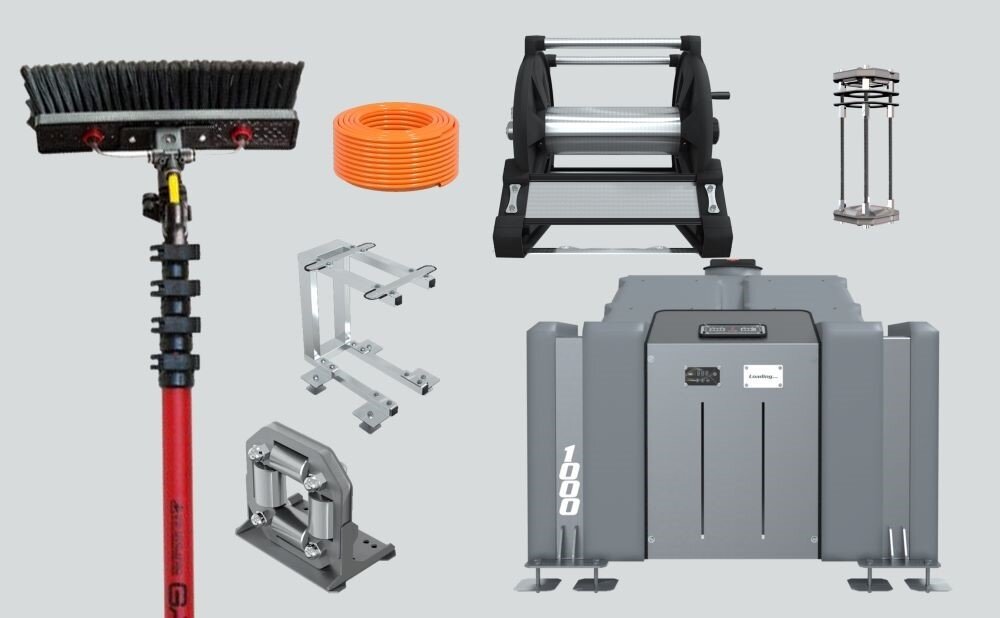
A window cleaning tank is only one part of your setup — the real efficiency comes when the tank, pump, controller and reel work together as a single, clean and well-organised system.
Waterworks tanks are designed to make this connection as simple and professional as possible, even for DIY installers.
Every component has a logical mounting position, reducing clutter and improving reliability.
Built-In Fixing Points for a Cleaner, Faster Installation
One of the biggest advantages of Waterworks tanks is the pre-moulded fixing positions that let you mount essential components directly onto the tank and door platform without drilling into the tank body.
These fixing points help secure:
- ✔ Pumps
- ✔ Controllers
- ✔ Strainers
- ✔ Wiring
- ✔ Victron B2B chargers
- ✔ PowerUP electric reels
Benefits:
- ✔ No messy or unsafe installations
- ✔ No drilling required
- ✔ Faster setup for both DIY and professional installers
- ✔ Cleaner cable and pipe management
- ✔ All components stay securely positioned
This creates a neater, safer and more professional system layout.
Direct Reel Mounting to Save Van Floor Space
Traditional installations mount the reel on the van floor or on a separate frame, which takes up valuable working space.
Waterworks systems allow you to mount reels directly onto the tank, which gives several advantages:
- ✔ Frees up floor space in the van
- ✔ Keeps reel at an ergonomic height
- ✔ Makes daily setup & pack-down faster
- ✔ Reduces bending and strain
- ✔ Creates a compact, professional look
This setup is ideal whether you’re using:
- PowerUP Electric Reels
- Waterworks Manual Reels
- Double-stacker reel configurations
It’s one of the biggest reasons professionals upgrade from older or DIY setups.
Dedicated Space for Pumps, Wiring & Controllers
The stainless steel door on every Waterworks tank system acts as an organised control panel.
You can mount:
- ♦ Digital flow controllers
- ♦ Battery chargers
- ♦ Pump switches
- ♦ Fittings and terminals
- ♦ Electrical wiring
- ♦ Hose connectors
This keeps everything:
- ✔ Accessible
- ✔ Neat
- ✔ Easy to maintain
- ✔ Protected from damage
A cleaner control area means fewer system failures and easier day-to-day operation.
Easy Upgrade Path for DIY Systems
If you already have pumps, controllers, or reels from a previous setup, Waterworks tanks make upgrading simple.
Because the platforms include:
- Pre-moulded positions
- Pre-drilled frame holes
- Universal fixing locations
…you can transfer your existing kit quickly without reinventing your setup.
This saves time and money, especially if:
- You’re moving from a DIY system
- You’re switching vans
- You’re upgrading from a smaller tank
- You’re adding a second operator
Your equipment fits straight onto the new platform without complicated drilling or fabrication.
A System Designed to Work as One
The combination of:
- Purpose-built tank
- Stainless steel frame
- Stainless steel door
- Integrated reel mounting
- Clean cable management
…creates a professional installation that works as a unified system, not a collection of parts.
This improves:
- ✔ Reliability
- ✔ Efficiency
- ✔ Workflow speed
- ✔ Ease of use
- ✔ Van organisation
For professionals, this means less time fixing problems and more time earning.
When to Upgrade From 500L to 750L or 1000L
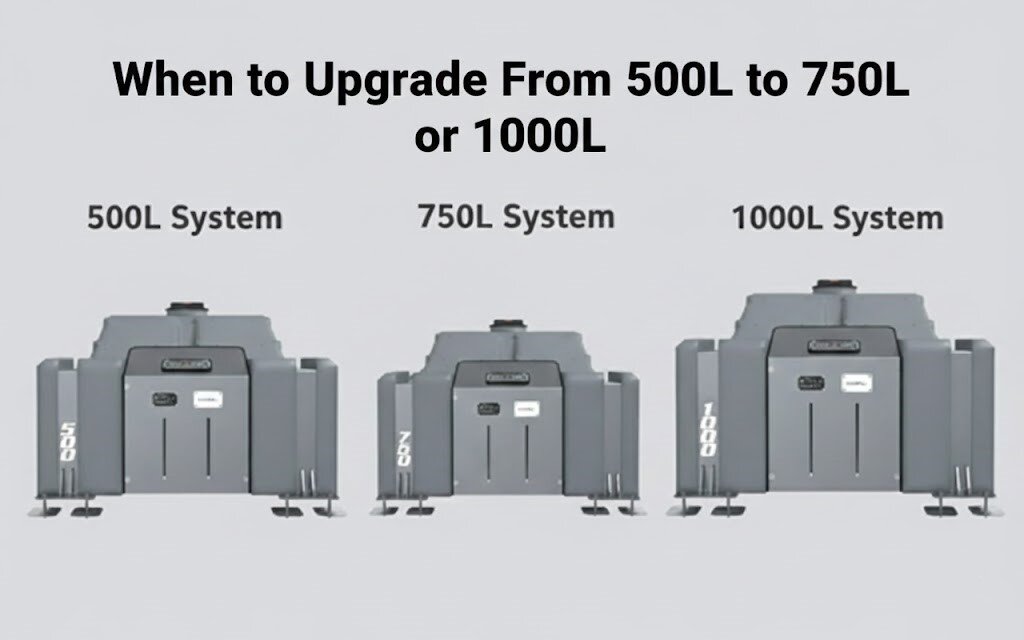
Your tank size should match your workload.
As your business grows, your water usage grows too — and choosing the right time to upgrade can help you work faster, take on bigger jobs, and avoid mid-day refills.
Here’s how to know when it’s time to move to the next size.
When to Upgrade From a 500L Tank
A 500L tank is perfect for smaller vans and domestic-focused routes.
But upgrading becomes worth it when any of these apply:
✔ You’re running out of water on busy days
If your residential route is now taking 5+ hours, or you’ve added more houses, you’ll notice water running low.
✔ You’ve started doing small commercial jobs
Shops, offices and first-floor commercial sites need more water.
✔ You want a two-man setup
Two operators can drain a 500L tank quickly.
✔ You’ve moved to a medium-size van
If you upgrade to a Transit Custom, Vivaro or Transporter — a 750L makes far more sense.
Best upgrade: Move to 750L
Gives extra runtime, stays compact, and fits medium vans perfectly.
When to Upgrade From a 750L Tank
A 750L tank covers most cleaners, but upgrading is smart when:
✔ You’re regularly working 6–8 hour days
Mixed domestic + commercial routes benefit from more water.
✔ You do large sites where refilling is not possible
Hotels, schools, long commercial routes, big housing jobs.
✔ You operate a full-time two-man system
Two operators working continuously use water fast.
✔ Your business has expanded beyond residential
If commercial work is now a core part of your day, capacity becomes important.
Best upgrade: Move to 1000L
You’ll get maximum runtime and zero refill interruptions.
When a 1000L Tank Is the Best Long-Term Choice
A 1000L tank isn’t only for large companies — it’s for anyone who wants the highest daily capacity.
Choose 1000L when:
✔ You want to eliminate refilling completely
Ideal for long days or multi-contract routes.
✔ You run a busy two-man operation
Two operators + continuous work = perfect for 1000L.
✔ You’ve moved into a large van
Transit, Master, Sprinter and similar vans handle the weight and space easily.
✔ You want to future-proof your setup
A bigger tank lets you grow into commercial work without needing another upgrade later.
1000L = maximum earning potential per day.
How to Choose the Perfect Upgrade Based on Your Workload
| Your Workload | Recommended Tank |
| Purely domestic, small routes | 500L |
| Domestic + small commercial mix | 750L |
| Large commercial routes | 1000L |
| One-man operation | 500L–750L |
| Two-man operation | 750L–1000L |
| No access to refills | 750L–1000L |
This simple table guides 90% of real-world cleaning businesses.
Upgrading Doesn’t Mean Replacing Everything
Thanks to Waterworks’ integrated fixing points and universal mounting locations:
- Pumps
- Controllers
- Chargers
- Reels
- Wiring
- Strainers
…can all transfer from your previous system.
This makes upgrading:
- ✔ Cheaper
- ✔ Faster
- ✔ Less labour-intensive
- ✔ More DIY-friendly
Whether you move from 500L → 750L → 1000L, your existing equipment can be reused.
Myths & Mistakes Window Cleaners Make When Choosing Tanks
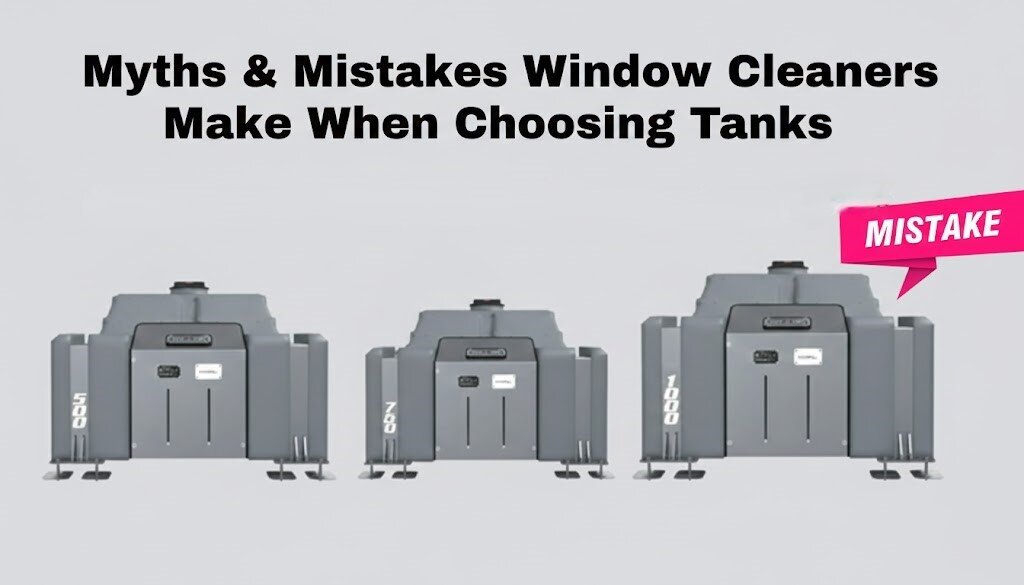
Choosing the right tank isn’t difficult — but a few common myths and assumptions can lead to unsafe setups, wasted money or unnecessary upgrades.
Here are the most important ones to avoid.
Mistake 1 — “Any plastic tank will do.”
Many beginners start with barrels, IBC tanks or repurposed containers.
But these are not designed for mobile use.
Problems include:
- Unsafe movement of water
- Poor weight balance
- Leaks from weak fittings
- Pumps struggling to draw water
- Equipment damage from excessive movement
A purpose-built tank system is designed for daily van use — which is why professionals choose Waterworks tank platforms.
Myth 2 — “Bigger tank = always better.”
A larger tank only makes sense when:
- Your workload requires it
- Your van can support the weight
- You regularly work long days without refills
Otherwise:
- Extra weight affects fuel economy
- Takes up more space
- Unnecessary cost for new cleaners
The right tank is the one that matches your route — not the biggest one available.
Mistake 3 — Securing tanks with straps or rope
One of the biggest DIY mistakes is trying to secure a tank with ratchet straps.
This is unsafe especially when the tank is full.
Risks include:
- Tank shifting during braking
- Sudden movement damaging pumps or wiring
- Unstable handling inside the van
A proper installation uses bolted mounting points, which all Waterworks frames support.
Myth 4 — “I can just place the tank anywhere in the van.”
Incorrect placement can affect:
- Van braking
- Weight distribution
- Stability while driving
The safest position is:
- Close to the van’s centre
- Over or near the rear axle
- On a solid, flat surface
Waterworks systems are designed to help with optimal positioning thanks to structured, compact frames.
Mistake 5 — Forgetting about future upgrades
Many cleaners buy based only on their current workload — then realise a year later they need more capacity or a two-man setup.
Upgrading is easier when your tank system:
- Has built-in mounting spots
- Supports manual + electric reels
- Has room for pump and controller expansions
- Fits multiple van types
Waterworks tanks are designed with these upgrade paths in mind.
Myth 6 — “DIY systems are cheaper in the long run.”
DIY seems cheap at first, but:
- Pumps fail more often
- Systems become messy
- More fittings leak
- Rewiring costs increase
- Van interior becomes cluttered
- You eventually replace everything with professional components
A clean, organised tank platform saves money by preventing breakdowns and reducing daily stress.
Quick Flowchart — Which Waterworks Tank Is Right for You?
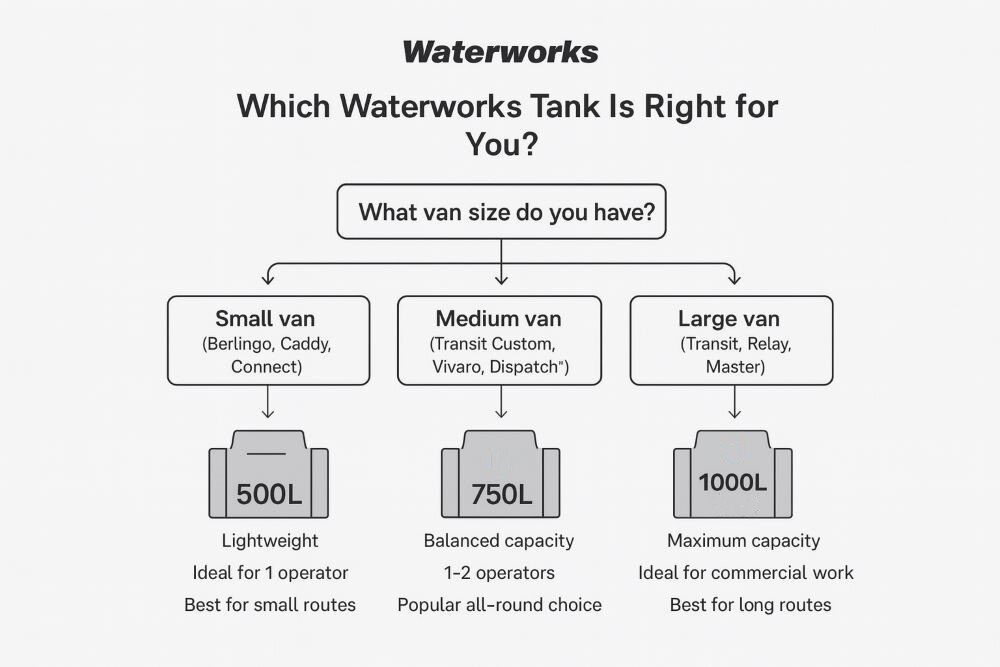
Step-by-Step Tank Selection Flow
1. What type of van do you have?
Small Van (Berlingo, Caddy, Partner, Connect) ➡ Go to Step 2 Medium Van (Transit Custom, Vivaro, Transporter, Dispatch) ➡ Go to Step 3 Large Van (Transit, Master, Sprinter, Relay) ➡ Go to Step 42. Small Van Route (Berlingo / Caddy)
Q: Do you work mainly on residential houses?- ✔ YES → 500L recommended
- ✖ NO → If mixed or commercial → 750L not suitable for small vans, consider upgrading your van first.
- ✔ YES → 500L is perfect
- ✖ NO → For longer days, consider moving to a medium van + 750L.
3. Medium Van Route (Transit Custom / Vivaro / Transporter)
Q: Do you do mostly domestic work but want extra capacity?- ✔ YES → 750L is ideal
- ✔ YES → 750L fits best
- ✔ YES → 750L or upgrade to 1000L depending on route length
4. Large Van Route (Transit / Master / Sprinter)
Q: Do you want maximum runtime with zero refills?- ✔ YES → 1000L recommended
- ✔ YES → 1000L is ideal
- ✔ Definitely → 1000L is the correct choice
Flowchart Summary (Fast Guide)
| Route Type | Best Tank Size |
| Small van + domestic work | 500L |
| Medium van + mixed routes | 750L |
| Large van + commercial work | 1000L |
| 1-man operation | 500L / 750L |
| 2-man operation | 750L / 1000L |
| Long days without refill access | 750L / 1000L |
Frequently Asked Questions About Window Cleaning Tanks (FAQs)

Here are the most common questions professionals ask when choosing the right tank size and system for their van.
1. How much water do I need for a full day of window cleaning?
Most cleaners use 80–150 litres per hour, depending on:
- Pole height
- Water flow rate
- Job type (domestic vs commercial)
- One-man or two-man setup
General rule:
- 500L = 3–5 hours
- 750L = 5–7 hours
- 1000L = 7–10 hours
2. Is a 500L tank enough for domestic window cleaning?
Yes — 500L is ideal for:
- Daily residential routes
- Small vans
- One-man operations
- Jobs that take 3–5 hours
If your day regularly exceeds this, upgrading to a 750L system is recommended.
3. Which tank size is best for a two-man team?
For two operators, the best choices are:
- 750L for mixed domestic + small commercial
- 1000L for longer commercial routes
Two operators can use water quickly, so a larger tank prevents mid-day refills.
4. Will a 1000L tank fit in any van?
No — a 1000L tank is suitable for large vans such as:
- Ford Transit
- Mercedes Sprinter
- Renault Master
- Peugeot Boxer
- Citroen Relay
Small and medium vans should use 500L or 750L depending on space and payload.
5. Can I install the tank myself?
Yes — Waterworks tanks are designed to be DIY-friendly because they include:
- Pre-moulded fixing points
- Pre-drilled stainless steel frames
- Stainless steel door for mounting pumps & controllers
However, if you’re unsure about bolting the frame to the van, you can always use a professional installer.
6. Can I reuse my existing pump, controller or hose reel?
Absolutely.
Waterworks tanks make it easy to transfer your existing equipment because:
- Mounting positions are universal
- Reels can be tank-mounted
- Controllers and pumps have dedicated fixing points
- Wiring layout is simple and clean
Upgrading your tank doesn’t mean replacing everything else.
7. Do I need an RO or DI system with the tank?
Not necessarily.
You have two options:
- Produce your own pure water using RO/DI
- Buy pure water from a supplier and store it in your tank
The tank works with both styles of cleaning.
8. Can I use my system without a frame?
No — a frame is essential for:
- Load safety
- Preventing tank movement
- Maintaining van stability
- Protecting pumps and wiring
- Proper bolting and anchoring
All Waterworks tank systems include a heavy-duty stainless steel frame for this reason.
9. Which tank is best for long commercial days?
The 1000L system is the top choice because `t provides the longest runtime without refills, making it perfect for:
- Office buildings
- Hotels
- Schools
- Multi-site routes
- Two-man teams
10. Do Waterworks tanks work internationally?
Yes — the tank systems are suitable for:
- UK window cleaners
- EU operators
- International businesses using water-fed pole setups
Because the system is based on simple, universal components (tank, pump, controller, reel), the design is compatible globally.
Final Thoughts — Choosing the Right Tank for Your Window Cleaning Business
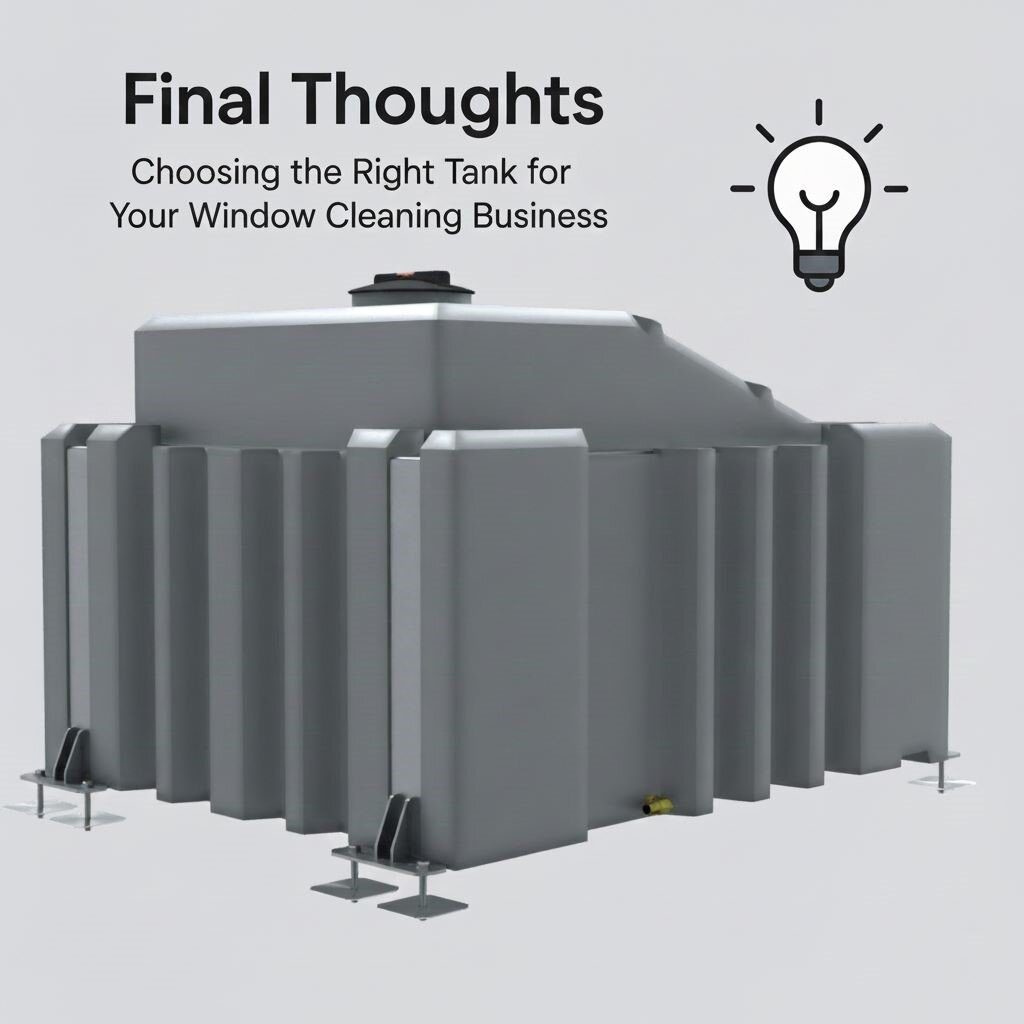
If you’re growing your window cleaning business, choosing the right tank is one of the most important decisions you’ll make as your setup evolves.
A reliable tank system is the foundation of every successful water-fed pole setup. Whether you choose a 500L, 750L or 1000L Waterworks Tank, Frame & Door Platform, the goal is the same: work efficiently, stay organised and keep your van safe and professional.
Small vans and domestic cleaners perform best with 500L systems.
Growing routes and mixed commercial work suit the 750L perfectly.
For the longest days and two-man teams, nothing matches the capacity of the 1000L.
Every Waterworks system is designed to save space, simplify installation and make daily work smoother — so you can focus on delivering better results, serving more customers and growing your business confidently.
If you’re ready to upgrade your setup, explore the Waterworks 500L, 750L and 1000L tank systems and find the perfect fit for your van and workflow.